Georges Le Saché for Vever Belle Époque Emerald Diamond Platinum and Gold Brooch-Cum-Pendant Necklace, Circa 1900
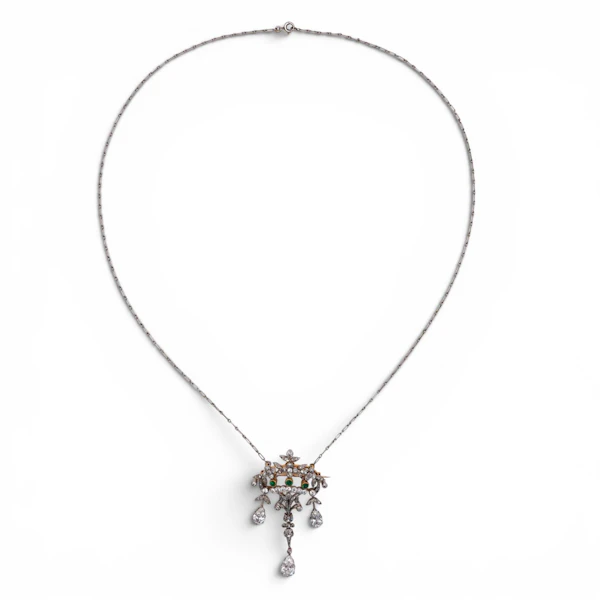
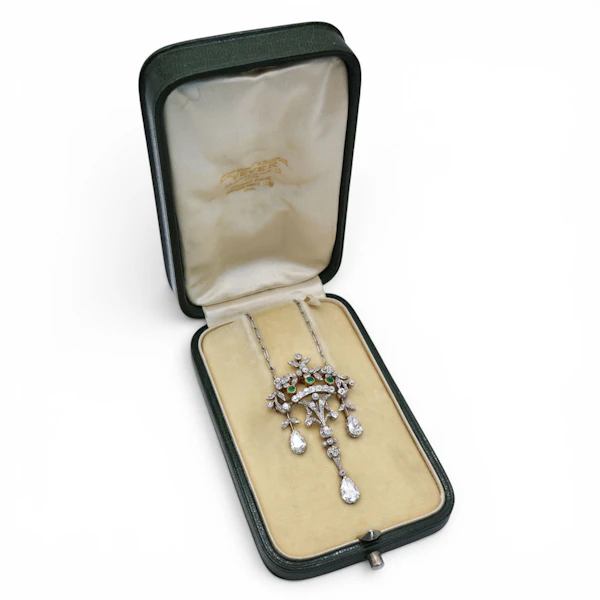
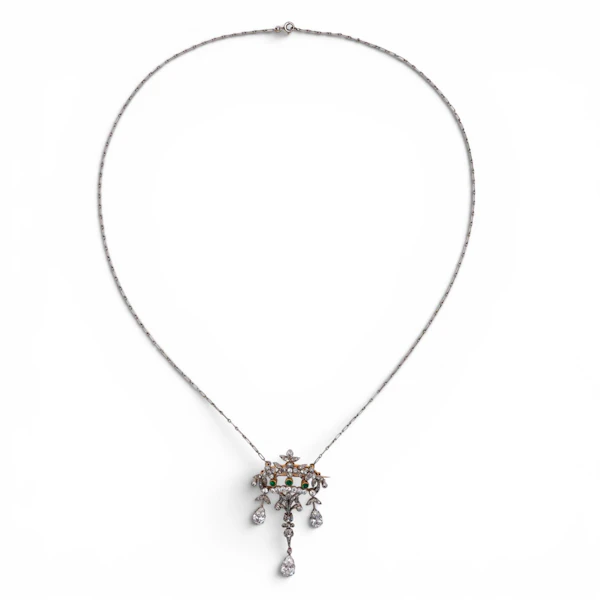


Georges Le Saché for Vever Belle Époque Emerald Diamond Platinum and Gold Brooch-Cum-Pendant Necklace, Circa 1900
£32,000.00
Description
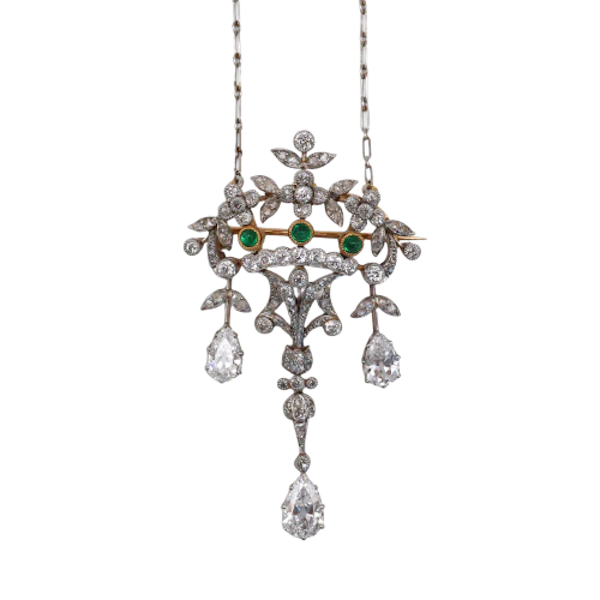
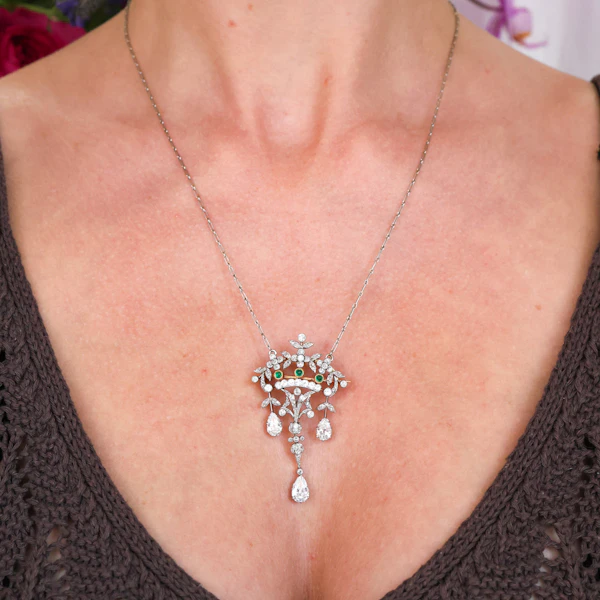
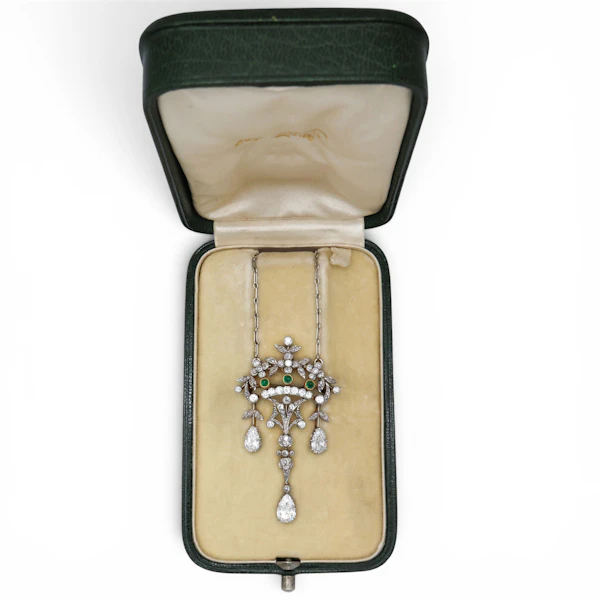
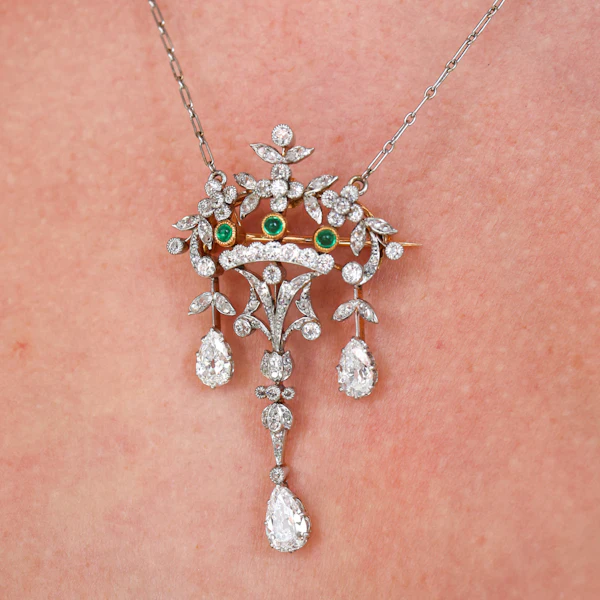
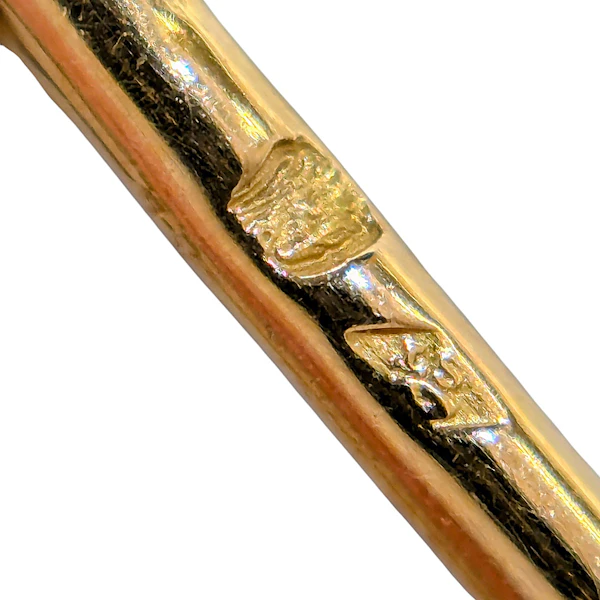
A French Belle Époque emerald, diamond, platinum and gold brooch-cum-pendant necklace, in an openwork design of a garland, with three cabochon-cut emeralds, in gold millegrain edged rub over settings below, over a stylised jardinière, with old-cut diamonds, in grain and millegrain edged rub over settings, with three articulating drops, set with pear shaped diamonds, in claw settings, mounted in platinum over gold, initialled M.D., with a removable brooch fitting, with with two, French eagle heads for 18ct gold, French makers marks with LS, in a lozenge, over an oval with a dot in the middle, which is a bobeche - a candle holder, for Georges Le Saché, whose marks were registered in 1885 and 1920, circa 1890. numbered 2698, with a removable, platinum, long and short link chain, in a green leather fitted case, with embossed M.P. initials, with a Vever logo on the silk interior, which reads, "Ane Mon Marret & Baugram Vever, 19 Rue De La Paix, Paris, Gand Prix, Exp Univ. Paris, 1889", containing a screwdriver to remove the brooch fitting. The emeralds have an estimated total weight of 0.30 carat and in our opinion, show characteristics of Columbian emeralds. Estimated total diamond weight 4.25 carats. In our opinion the colour is G to H and our opinion of the clarity is VS.
Vever
Georges Le Saché was a respected French jewellery designer and manufacturer who created pieces for some of the most prominent jewellery houses of the late 19th and early 20th Centuries. Born into a creative family in Paris in 1849, Georges Le Saché showed artistic promise early in life. His grandfather Jean-Jacques Le Saché was an engraver for the Paris Mint and was commissioned by the Mayor of Ghent in 1810 to make a medal for which he was praised not only for “the imaginative handling of the subject” but also the “meticulous craftsmanship evident in the piece”. His father, Emile, was a talented draughtsman, with a particular skill for line engraving, whilst his mother ran a jewellery shop in Paris’s Palais Royal.
The young George wanted to be a painter. His creative talents were nurtured and inspired by spending much of his early youth with artists, including one of the best academic painters, William-Adolphe Bouguereau. He planned to attend the Ecole des Beaux-Arts in Paris however his parents wanted a more secure career path for him. Fearing the life of a painter was too unstable, they sent him to Germany, in 1866, at the age of 17. He worked for the renowned jewellery firm, Friedman, which was well known in France at the time and where Carl Fabergé would go to train a few years later. Le Saché's his skill as an artist was quickly recognised and he worked on the rendering of designs, whilst being exposed to all aspects of the jewellery trade. He then travelled to England where he studied and learnt as much as possible, applying his knowledge of drawing and design to a variety of decorative arts. At the outbreak of war in 1870 he returned to France, where he spent six months serving in the 1st battalion of the Seine regiment, until March 1871. He then returned to London for another year, until settling back in Paris, finding work as a designer for the jeweller Lucien Falize.
This proved an important period in Le Saché’s life as he and Falize became friends as well as professional collaborators. Falize taught him much about the jewellers’ art and Le Saché's position enabled him to study a wide variety of wonderful jewels, both antique and contemporary. The craft of the goldsmith inspired Le Saché’s designs, leading him to become a knowledgeable and skilled manufacturer, thanks to the careful tutelage and encouragement of his friend. After five years of working with Falize, Le Saché left, to join the highly regarded manufacturing jewellery company, Baucheron et Guillain, in 1877. His marriage to Baucheron’s daughter made a move to the family business almost inevitable. Eventually he would take it over as his own. He soon came to create pieces for some of the most famous Parisian jewellery houses of the period, who exhibited his pieces at the world fairs, both in Paris and internationally. He also attracted the attention of the American jewellers, Tiffany & Co., who commissioned various pieces from him.
Le Saché ran his workshop for over thirty years, preferring to remain anonymous. He worked to commission and sold only through agents. His workshop trained a steady stream of apprentices and craftsmen, never forgetting his enriching five years with Falize. The quality of his work spoke for itself. He was recognised by his peers, in 1901, with a large silver-gilt plaque, awarded for what Henri Vever referred to as the “rare talents and absolute integrity of an excellent artist and manufacturer”. Despite never seeking attention for himself his pieces are now in some of the most important jewellery collections in the world.
With thanks to Hancocks.
Approximate weight: 13.9 grams
| item details | |
|---|---|
| Origin | French |
| Period | Early 1900s |
| Style | Edwardian |
| Condition | Good |
| Materials | Gold |
| Platinum | |
| Main Gemstone | Diamond |
| Main Gemstone Cut | Pear Cut |
| Main Gemstone Clarity | VS |
| Main Gemstone Carat | 4.25 carats |
| Main Diamond Colour | G-H |
| Dimensions | Length 51.3mm, width 29.5mm |
| Secondary Gemstone | Emerald |
| Secondary Gemstone Carat | 0.30 carat |
| Secondary Gemstone Cut | Cabochon Cut |
Product REF: XAZ17626P2
