A 'LONGQUAN' CELADON-GLAZED TRIPOD CENSER
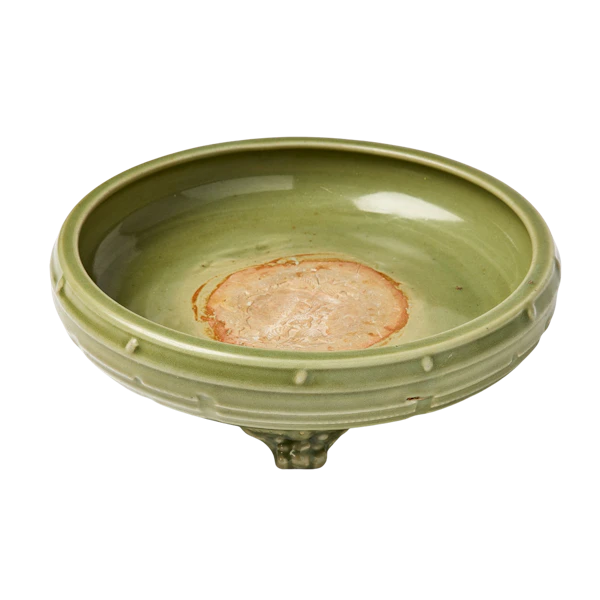

A 'LONGQUAN' CELADON-GLAZED TRIPOD CENSER
POA
Description
Supported on three mask-and-paw feet, the broad shallow sides rising to an incurved rim, crisply moulded to the exterior with the 'Eight Trigrams' between registers of raised bosses, all under an unctuous blue-green glaze, the centre unglazed and impressed with a leafy floral spray, the protruding disc at the base also unglazed, both burnt orange in the firing.
Period: Late Yuan / early Ming Dynasty
Celadons were highly prized for their resemblance to jade and the beauty of their glaze. They were exported across Southeast Asia and the Middle East some time before significant European involvement in the trade of Asian ceramics. The celadons of the Longquan kilns in Zhejiang province were among the finest produced in China, and the potters there led stylistic and technical developments in celadon production from the Song Dynasty (960-1279) through to the early Ming (1368-1644). The range of glaze colour from greyish to blueish greens results from the impact of variations in kiln temperature and atmosphere on the iron oxide within the glaze.
PROVENANCE: Collection of Wilfred Fleisher (1897-1976), acquired in Japan in the 1920s to early 1930s, and thence by descent.
From the collection of Mr. Wilfred Fleisher, Editor and thence by descent to the current owner.
Mr. Wilfred Fleisher was born in 1897, the son of Benjamin W. Fleisher who was the founder in 1907 of The Japan Advertiser. An important English-language newspaper, indeed the first English -language newspaper in Japan.
After graduating from the Colombia School of Journalism and working for the United Press in Paris and Siberia, Wilfred Fleisher returned to Japan to work on his father's newspaper as Editor-in-Chief.
It was at this time he became very interested in Asian art and amassed a substantial collection of works of art, Japanese as well as Chinese. He purchased the majority of his pieces from reputable dealers of the time such as Mayuyama, Kochuko and Yamanaka. The entire collection was acquired during the 1920's and early 1930's.
In November 2003, Christie's London offered a 'very rare Imperial Mughal-style white jade cup', dating to the Qianlong period (1736-1795) from his collection, illustrated on the front cover of their catalogue.
| item details | |
|---|---|
| Origin | Chinese |
| Period | 17th Century |
| Dimensions | Diameter: 31cm; 12 ins. |
Product REF: BK12
