A PAIR OF BLUE AND WHITE POMEGRANATE TUREENS AND COVERS
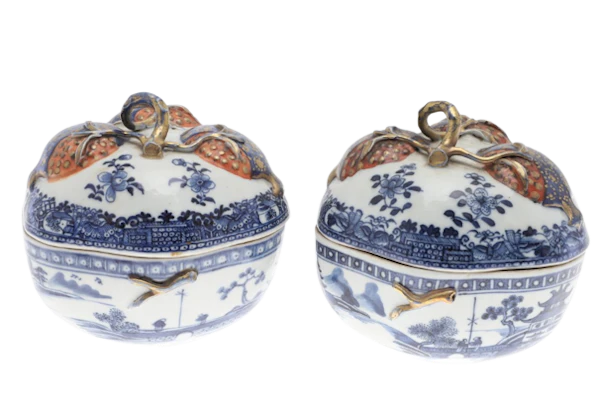

A PAIR OF BLUE AND WHITE POMEGRANATE TUREENS AND COVERS
POA
Description
formed of undulating lobes, applied with a gilt pomegranate head and stem to either side, painted on the body with, on one side, a man riding a horse with an attendant in a landscape dotted with trees and pagodas and mountains in the distance, the other side painted with a man in a boat in a watery landscape with pagodas and a house in the background, the covers with three raised pomegranates, each bursting open to reveal seeds detailed in iron red enamel and gilt, the gilt finial in the form of a slender twisting stem, further decorated with floral sprays and an intricate border of roe and flowers around the rim, the base glazed.
Period: Qianlong (1736-1795) c. 1775
Footnote: In Chinese art, the pomegranate represents fertility. It is possible that these unusual tureens were designed originally for export to the Iberian Peninsula; the pomegranate was the emblem of the Kingdom of Grenada, and some such tureens are known to have been discovered in Portugal.
For a similar example, see William R. Sargent, Chinese Porcelain in the Conde Collection, Madrid, p.254-255, no.101. Also see Maria Antonia Pinto de Matos, The RA Collection of Chinese Ceramics, Vol.2, no.245.
A famille rose example can be found in China for the West, by David Howard and John Ayers, p.184-185, no. 181
For another pomegranate-form tureen decorated in underglaze blue, see Jorge Welsh, Fauna & Flora – A Collection of Qing Dynasty Porcelain, Jorge Welsh Oriental Porcelain and Works of Art, London and Lisbon, 2002.
| item details | |
|---|---|
| Origin | Chinese |
| Period | 18th Century |
| Dimensions | 12cm high, 14.5cm at widest point. |
Product REF: BK14 BK15
