A CHINESE BLUE AND WHITE KENDI


A CHINESE BLUE AND WHITE KENDI
POA
Description
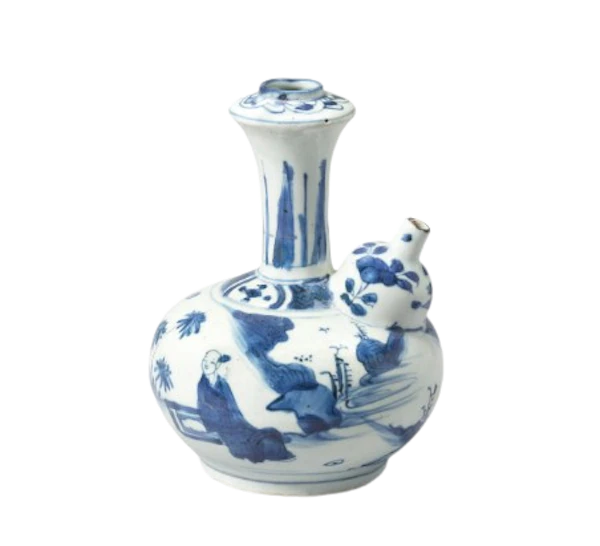
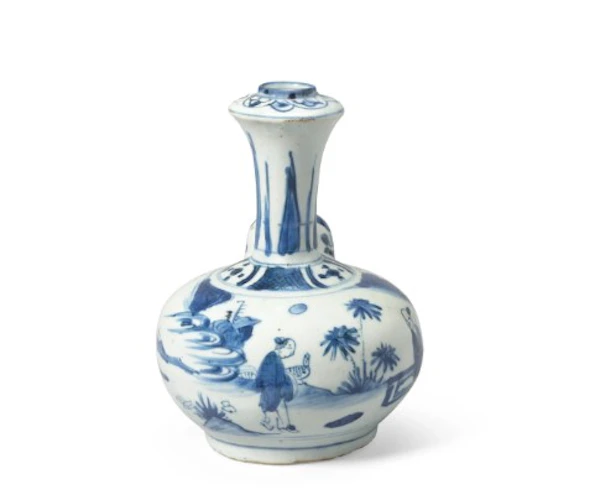
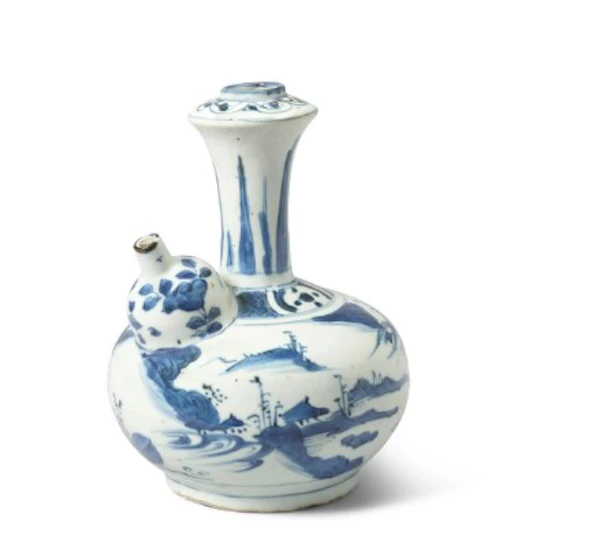
The compressed rounded body supported on a circular foot, the wide sloping shoulder set with a domed spout, rising to a tall slender neck with an everted rim, decorated in shades of underglaze blue, the body painted with a scene of two robed seated figures in a terraced garden, an attendant and a scholar, the attendant proffering a goose, surrounded by rockwork and swirling clouds, the shoulder with a band of chimes and diaper pattern, the neck with freely painted upright plantain leaves, the mouth with an abstracted petal pattern, the base glazed.
Period: Chongzhen (1627 - 1644)
Footnote:
The painting of this kendi is typical of the `High Transitional` style found at the end of the Ming, for a comparable example (but with a different motif) see The Oriental Ceramic Society of Hong Kong and Hong Kong Museum of Art, the Urban Council, Transitional Wares and Their Forerunners, Hong Kong, 1981, p.86, no.47.
The scene on our kendi depicts Wang Xizhi (303–361), one of the greatest calligraphers in Chinese history, and in particular his love of geese. As the story goes, there was a Daoist priest living nearby who had raised a flock of geese. Wang Xizhi paid him a visit in order to see the geese and found it hard to tear himself away from them. Wang Xizhi pleaded with the priest to sell the flock to him. The Daoist priest made him a counter offer: ‘I will let you have the whole flock if you write a copy of Laozi’s Daodejing text for me.’ Wang Xizhi willingly did this and went home happily with the geese.
Kendis were largely produced for the Southeast Asian market and were used as pouring or drinking vessels, designed to be held by their spout. Chinese vessels, kendi, were used for drinking or pouring, the Persians adapted and used for smoking and they became ghalian bases.
| item details | |
|---|---|
| Origin | Chinese |
| Period | 17th Century |
| Dimensions | Height: 19.5cm (7 5/8in) |
Product REF: BK17
