A JAPANESE ARITA TANKARD
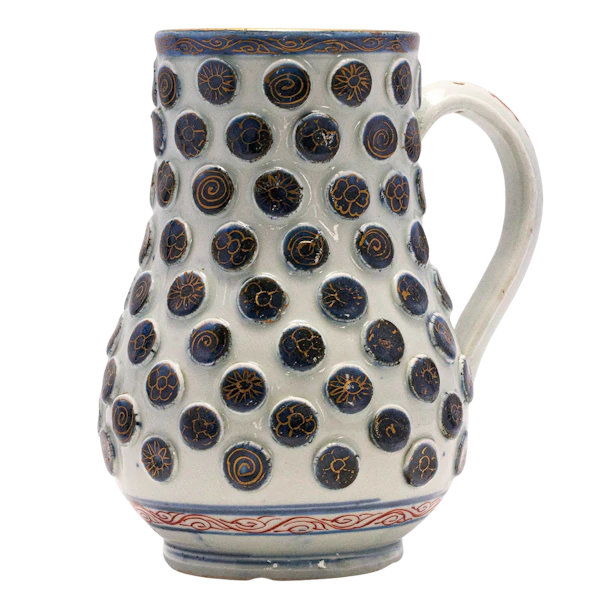


A JAPANESE ARITA TANKARD
POA
Description
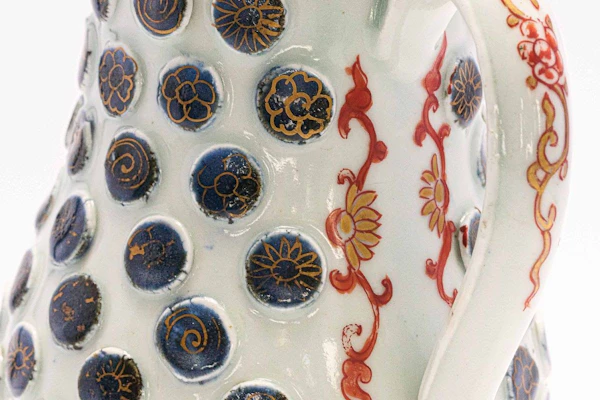
Based on a European design, probably of German stoneware form and shape, with a rounded body and wide cylindrical neck, set with a 'C'-shaped handle, the body applied with bands of moulded dark blue bosses in low relief, each painted with a gold outline of different types of flower-heads alternating with swirls, around the neck a thin band of gilt scroll-work on a dark blue ground, the foot with a pattern of scroll-work in iron-red, the handle attachments adorned with a gilt lotus with iron red scrolls, the handle painted with a further scrolling lotus bloom, the base glazed.
Period: Edo, late 17th early 18th century
Footnote:
For a similar example see Dr. C. J. A. Jörg, Interactions in Ceramics Oriental Porcelain and Delftware - Catalogue of an Exhibition January to February 1984, jointly presented by the Urban Council of Hong Kong and the Consulate General of the Netherlands, published by the Urban Council 1984, no. 81, p. 126, and catalogued as Japanese porcelain Arita, late 17th Century, height 16 cm, Jörg writes, and we quote:
"Tankards of Japanese porcelain in various sizes were much in demand and regularly ordered by the Dutch East India Company, starting in 1663. In order to obtain the desired - European - form, models were sent with the orders, mostly tankards of German stoneware. Most 17th Century Japanese tankards are painted in blue with semi-Chinese Transitional decoration or a more Japanese decoration with vertical panels and foliate scrolls (cf. cat. no. 61). They were provided with silver or pewter lids in the Netherlands. This example differs from the normal type, the decoration of discs indicating a literal copy of a German model. This is something only sporadically found in Japanese porcelain, so that this piece can with justice be called a rarity."
For a further comparable example in both form and decoration, refer to Fine and Curious: Japanese Export Porcelain in Dutch Collections by Dr. C. J. A. Jörg, page 168, plate 199. This example is in the collection of the Princesshof Museum Leeuwarden (GMP 1968-51).
The British Museum has a similar tankard (museum number 2015,3013.1). They describe theirs as 'Hizen ware' produced at Arita in the late 17th or early 18th century (1680s - 1720s). They note that the form is 'based on a Rhenish Westerwald stoneware prototype'. For an example of what the 17th century Westerwald prototype may have looked like, albeit with the blue decoration inverted, see The Philadelphia Msueum of Art (accession number 1877-206). The example in the Rijksmuseum is catalogued under the Object Number AK-NM-2087.
| item details | |
|---|---|
| Origin | Japanese |
| Period | 17th Century |
| Dimensions | Height: 16cms, 6.25 in |
Product REF: BK08
