A RARE MING BLUE AND WHITE BRUSH HOLDER IN THE FORM OF A TABLE SCREEN


A RARE MING BLUE AND WHITE BRUSH HOLDER IN THE FORM OF A TABLE SCREEN
POA
Description
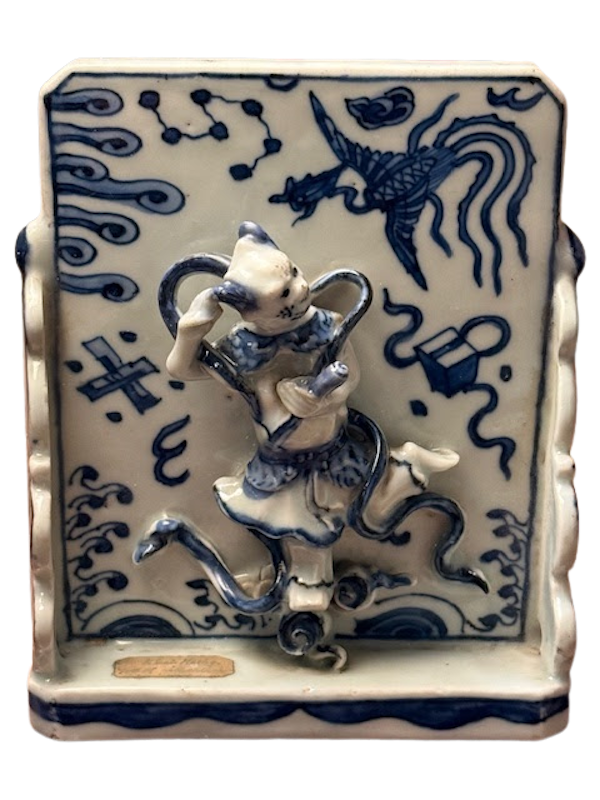
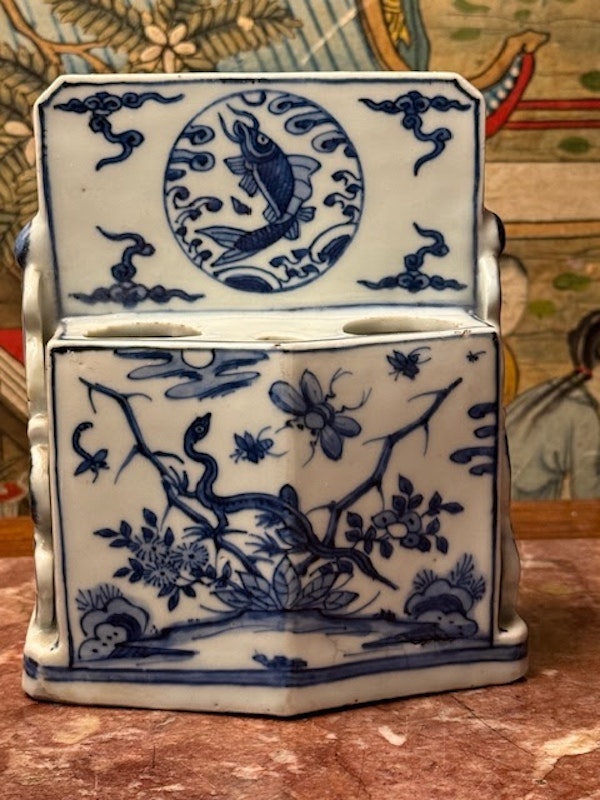
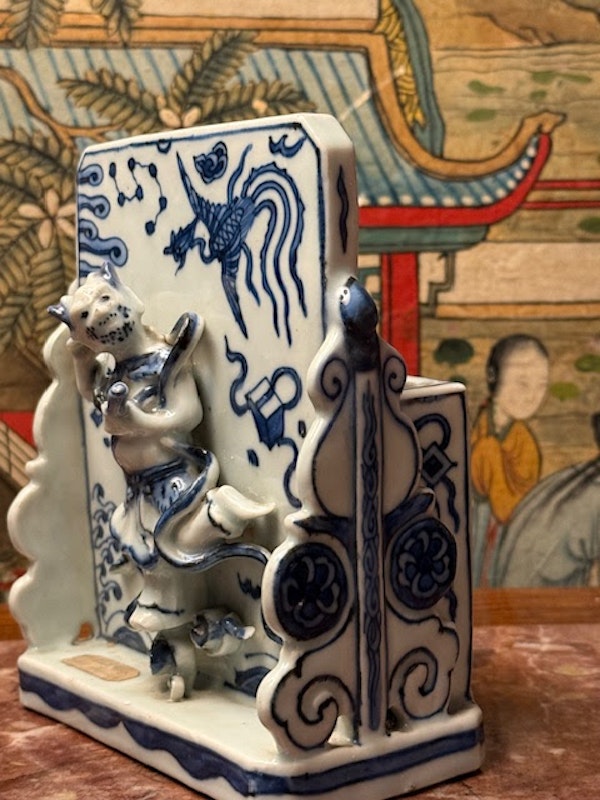
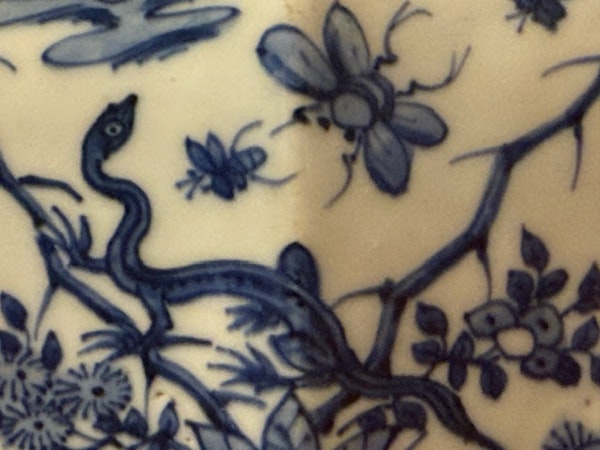
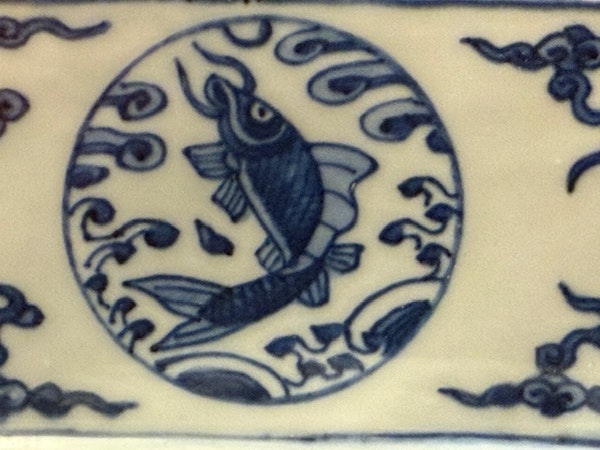
The screen is moulded and decorated in shades of bright cobalt-blue to one side with Kui Xing in relief, his scarves billowing in the wind, one foot resting on stars the other in his iconic 'back-kick' posture, surrounded by crashing waves. Above Kui Xing the sky with the north star constellation and clouds and out of the sky a phoenix swooping down, the background with auspicious symbols. The other side of the screen has a lower section with three circular apertures, the front is decorated with a panel of a finely delineated lizard balancing on a branch looking at three butterflies in a garden setting, below a further panel depicting a carp leaping from waves. The sides with ruyi-shaped supports.
Period: Ming Dynasty, Wanli Period (1573 - 1620)
Provenance:
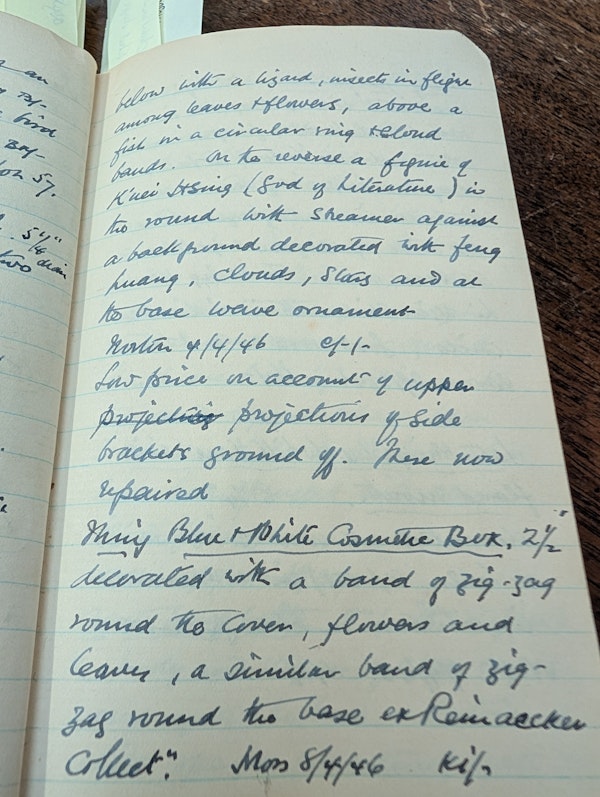
Henry Potter Stevens Collection no. 41, bought from H.R.N Norton 4th April 1946
Bought from Norton 4/4/46 c/-/- = £ 2
Dr. Stevens price code Price code- B 1/ U/ 2 C/ 3 K/4 I/5 N/6 G/7
Footnote: Identified by the writing brush held in his right hand and his iconic 'back-kick' posture, Kui Xing (‘Chief Star’) the Daoist deity was worshipped by all wanting to obtain academic success. This brush pot on a scholar's desk must have given hope of good results. As God of Literature, he was worshipped by candidates to the imperial examinations. Dreaming of Kui Xing the night before the exams was considered an auspicious sign.
He is said to have been an historical figure, a poor but brilliant student called Zhong Kui who passed the imperial examinations with high honours. However, because he was ugly, he was not allowed to enter government service. In despair, he drowned himself but was carried by a fish-dragon up to heaven where he became a star ('Xing' in Chinese) of the Great Bear constellation (known in China as the Palace of Literary Genius).
Kui Xing is also the chief star in the Big Dipper constellation.
According to Chinese legend, the yellow river carp travelled upstream to overcome the rapids of the Lung-Men (Dragon Gate), where, if they were capable and brave enough to make the final leap over the waterfall, they were magically transformed into glorious dragons. This metaphor relates to the dedication and determination required by students to succeed in passing exams.
See a similar blue and white brush stand, Wanli, illustrated by John da Silva, 'Three Types of Chinese Brush Stand', Oriental Art, vol.XXIV, no.3, autumn 1978, p.327, figs.3-5.
In the collection of the Ashmolean Museum, Oxford, there is a similar brush pot of the same ‘screen’ form, also relief decoration of Kui Xing (object number EA1980.397, bequeathed by E. H. North in 1980).
There is a wucai-enameled scholar’s desk screen, also Wanli period (1573-1620), illustrated in China without Dragons: Rare Pieces from Oriental Ceramic Society Members. Catalogue of an Exhibition of the Oriental Ceramic Society at Sotheby’s, London, 3-9 November 2016, fig.173. This screen is part of the collection of Sir Michael Butler (1927 – 2013).
| item details | |
|---|---|
| Origin | Chinese |
| Period | 16th Century |
| Dimensions | Height: 16cm |
Product REF: BJ69
