An Indian colonial-period Silver Salver or presentation Silver tray, 1865
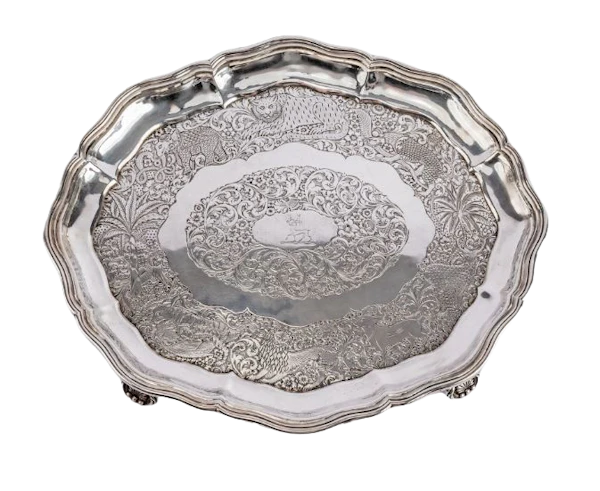


An Indian colonial-period Silver Salver or presentation Silver tray, 1865
£3,900.00
Description
An Indian colonial-period Silver Salver or presentation Silver tray, 1865
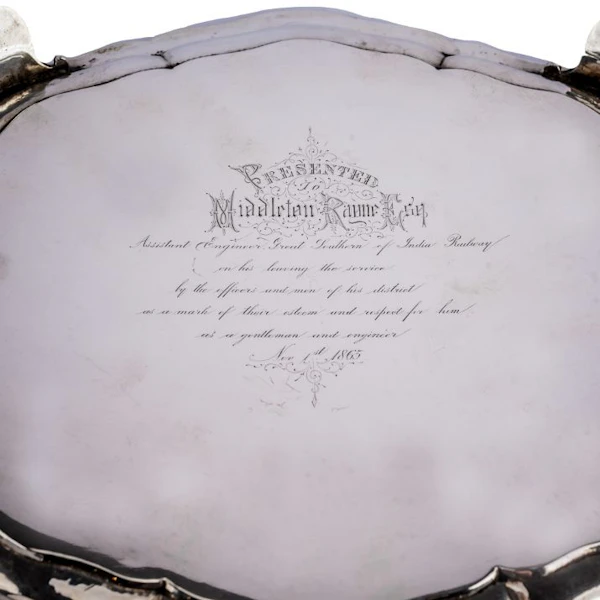
This Silver Tray appears to be a Testimonial Address to an Assistant Engineer, Great Southern India Railway to honor an unnamed Assistant Engineer upon his departure from the company's service, presented to a departing railway engineer in 1865.
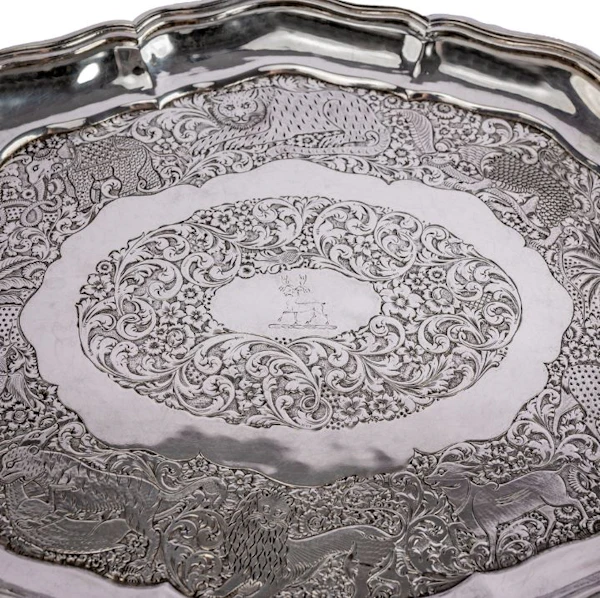
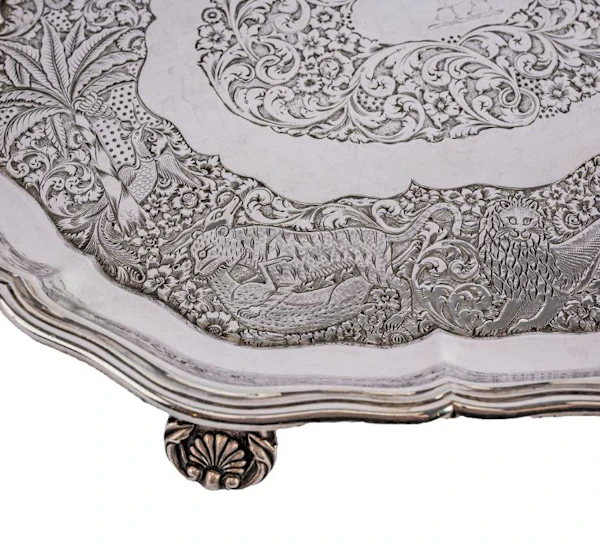
This large silver salver is of shaped circular form with a scalloped rim and raised on scroll feet. The surface is richly decorated with intricate foliate scrolls, flowering plants, and ornamental arabesques executed in high relief. At the centre is an oval reserve engraved with a sailing ship, enclosed by dense scrolling foliage. The broad border is similarly embellished with finely chased floral ornament characteristic of luxury silver produced in colonial India during the late nineteenth century.
The tray exemplifies the highly decorative silverware made by Indian craftsmen for both local patrons and the British export market during the period of the British Raj. Workshops in Bombay, Calcutta, and Madras became renowned for their technical virtuosity, combining Indian decorative traditions with forms popular in Victorian Britain. Such salvers were often commissioned as presentation pieces, commemorative gifts, or prestigious dining accessories.
The elaborate workmanship reflects the skill of Indian silversmiths who employed chasing, repoussé, and engraving techniques to create richly textured surfaces that appealed to European tastes while retaining distinctly Indian ornamental vocabulary.
The Great Southern India Railway was one of the major private British companies that built and operated India's early railway network. In 1865, the Indian railway system was still in its rapid expansion phase, with construction driven by both commercial interests and the colonial administration's strategic and administrative needs. This item offers a tangible connection to that era of railway history.
The text is arranged in a formal, hierarchical style typical of Victorian presentation pieces. It begins with the word "PRESENTED" in large type, followed by the recipient's designation as "Assistant Engineer Great Southern India Railway" and the reason for the gift—his "leaving the service." The plaque records that the presentation was made by the "Officers and men of his district" as "a mark of their esteem and respect for him as a gentleman and engineer," a phrase that highlights the Victorian values of professional competence and personal character.
The inscription raises intriguing historical questions. While this specific Assistant Engineer is not named on the item, records show that a Robert White (1842-1925) joined the Great Southern India Railway as an Assistant Engineer in 1869—a few years after this 1865 date. This suggests either an earlier, unidentified engineer, or that this is a general style of presentation from the period.
The plaque is a significant artifact for understanding the social and professional hierarchies of colonial railway enterprise. It demonstrates the formalized nature of professional relationships and the importance placed on recognition and respect between ranks, from senior officers to the "men" working under them.
Measurements:
Length: 29,3 cm
Width: 24,3 cm
Height: 3,4 cm
Total Weight: 781 grams
| item details | |
|---|---|
| Material and Technique | Silver |
| Origin | Other |
| Period | 18th Century |
| Condition | Excellent |
| Dimensions | Length: 29,3 cm Width: 24,3 cm Height: 3,4 cm Total Weight: 781 grams |
Product REF: JC-SILV-07232
