Ceremonial Solid Silver Kutch Water Vessel Gangajali 1910


Ceremonial Solid Silver Kutch Water Vessel Gangajali 1910
£18,500.00
Description
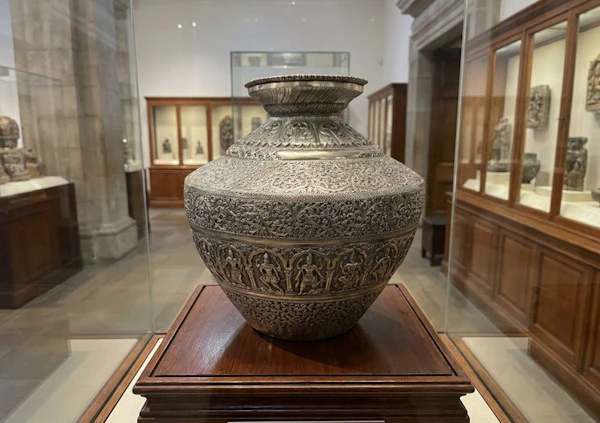
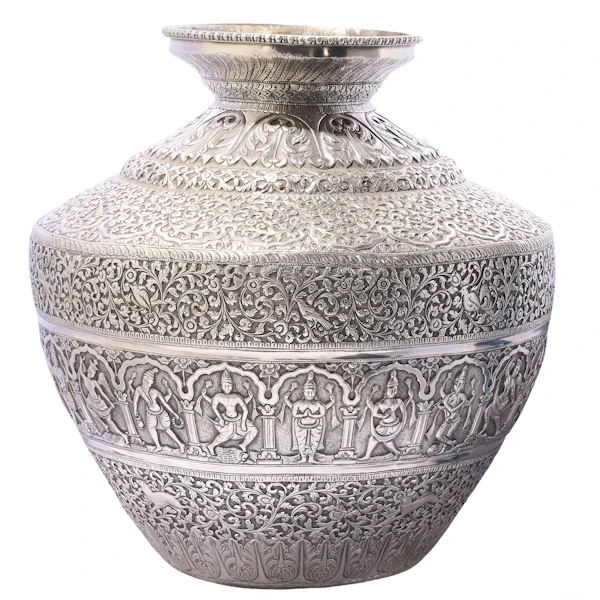
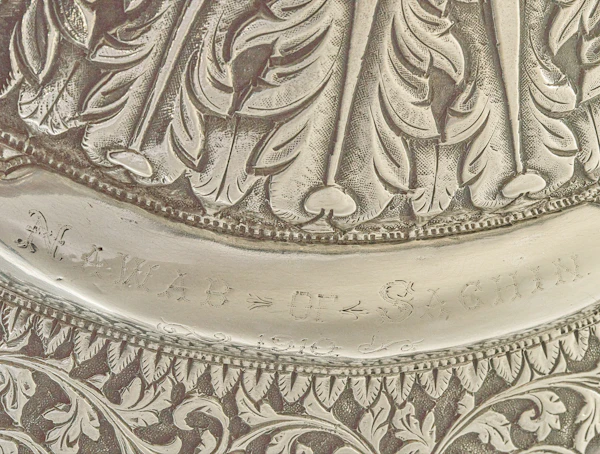
This Ceremonial Solid Silver Kutch Water Vessel (Gangajali) was commissioned for the court of the Nawab of Sachin, Gujarat, in the Bombay Presidency, Western India, Circa 1910, Repoussé and chased silver.
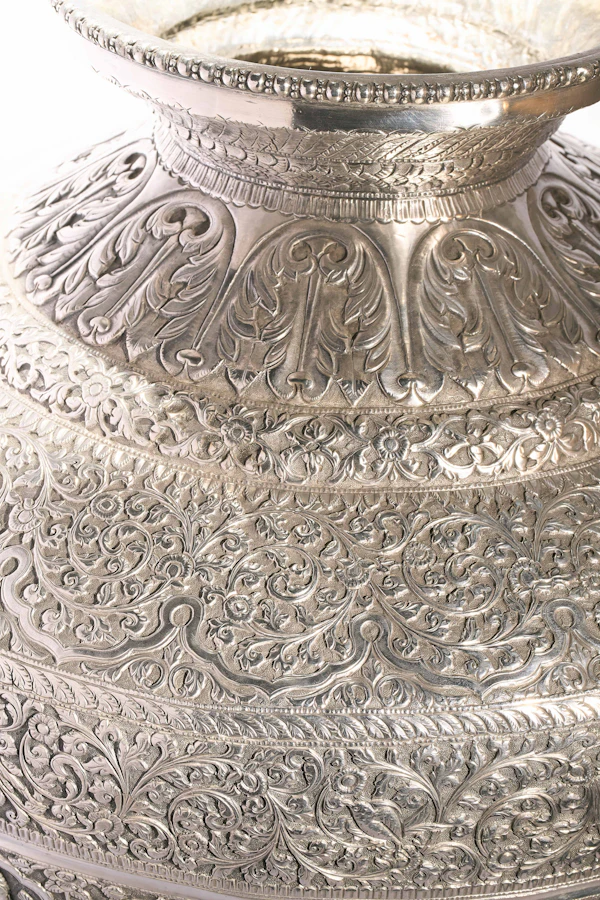
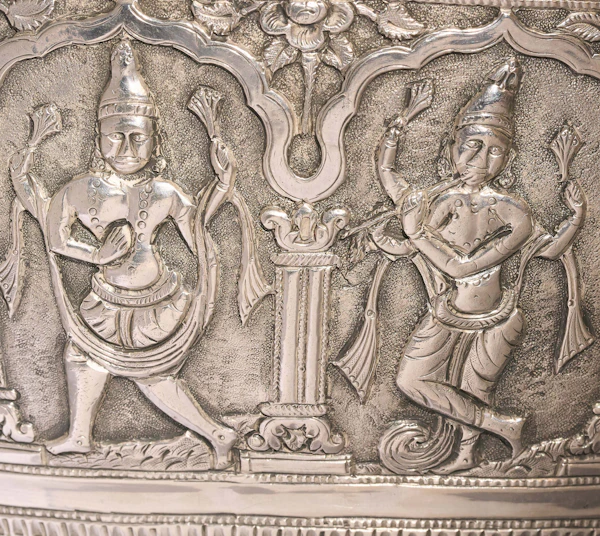
This monumental Silver Kutch Water Vessel exemplifies the extraordinary craftsmanship of western Indian silversmiths during the late princely era of British India. The vessel is densely ornamented with intricate scrolling floral arabesques, foliate bands, and narrative figural friezes executed in high repoussé and fine chasing techniques. The elaborate surface decoration reflects the luxury aesthetic favoured by princely courts in Gujarat during the early twentieth century.
Traditionally associated with the Nawab of Sachin, the Solid Silver Kutch Water Vessel may have been produced for ceremonial court use, palace display, or diplomatic presentation. The princely State of Sachin, located near Surat in present-day Gujarat, was ruled by the Nawabs of the Siddi dynasty, an elite Muslim lineage of African origin that maintained close political and cultural ties with the British Raj while patronizing regional artistic traditions.
The State of Sachin was founded in 1791 by Sidi Abdul Karim Muhammad Yakut Khan I, a member of the Siddi community — people of East African (Habshi/Abyssinian) origin who had risen to military and political prominence in western India.
The Siddis originally arrived in India through Indian Ocean trade networks, military service, and royal courts. Over centuries, some became admirals, generals, governors, and rulers in the Deccan and Gujarat.
After political struggles in Janjira, Sidi Abdul Karim entered into an agreement with the Maratha Peshwa and received the territory of Sachin near Surat, creating a new princely state.
This image shows an ornate Gangajali, which is a container used to hold water from the Ganges River for Hindu purification purposes. Specifically, based on the craftsmanship and historical context, it appears to be a princely solid silver Gangajali.
Objects of this type were often commissioned from master workshops in Gujarat, Kutch, and Bombay between 1890 and 1915, a period marked by increasing demand for presentation silver among Indian princely states and colonial elites. The exceptional density of ornament and technical refinement suggest manufacture by a highly skilled court or metropolitan workshop.
The Ceremonial Solid Silver Water Vessel Gangajali is connected to the “Nawab of Sachin” and dated 1910, the ruler at that time was:
Sidi Ibrahim Muhammad Yakut Khan III
He became Nawab as a child in 1887 and ruled during the height of the British Raj. He was educated in the British imperial system, served with honorary military rank in the British Army, and acted as Honorary Aide-de-Camp to the Governors of Bombay between 1906 and 1910.
This was exactly the period when luxury silver objects, presentation vases, ceremonial vessels, and palace decorative arts flourished among Indian princely courts.
The Nawabs of Sachin became known for:
patronage of luxury arts,
Indo-Islamic court culture,
horse racing,
architecture,
music,
and cosmopolitan lifestyles blending Indian, African, and British influences.
The family also became connected to early Indian cinema through: Fatima Begum and her daughter’s Sultana and Zubeida.
Fatima Begum is widely believed to have been married to Nawab Ibrahim Muhammad Yakut Khan III, though aspects of the relationship remain debated in historical records.
Sachin state was established on 6 June 1791 with over 85% of its population being Hindus, while the other parts, mostly their rulers, being Sunni Muslims of the Sidi dynasty of Danfa-Rajpuri and Janjira State. The Sidi dynasty is of Habesha origin, people culturally and ancestrally related to the ethnic groups in the Ethiopian highlands in Africa.
Sachin state, before it came under the British protectorate, was under the protection of the Maratha Peshwa (likened to a modern-day prime minister). In 1829, the state became bankrupt; this brought the state under British civil administration between 1835 and 1864. It had its own currency, Calvary, and stamped paper, including a state band with Africans inclusive.
One of India’s cinemas earliest superstars, Fatima Begum (1892- 1983), who was also India’s first female film director, was said to have been allegedly married to Nawab Sidi Ibrahim Muhammad Yakut Khan III of Sachin state. But sources from the Sachin royal family throw a veil over this, and they claim no record of the marriage or contract between the Fatima Begum and the Nawab. They also claim no record of the Nawab recognizing her children, Sultana, Zubeida and Shehzadi as his own. The Nawab at that time had a daughter called "Sultana" born in 1910. It is plausible, though not definitively established, that this vessel was presented to her father to commemorate the birth of his daughter, Sultana. Fatima Begnum’s daughter, Sultana, became a key figure in early Indian movies. Zubeida, Sultana’s younger sister, became a leading actress in Indian’s first talkie film Alam Ara in 1931. Nawab Sidi Ibrahim Muhammad Yakut Khan III, the last ruler of Sachin state, signed the agreement to join the Indian union on 8 March 1948 and the state became part of Surat district in Bombay Province.
Zubaida stayed in India after the partition, while her sister moved to Pakistan where she got married and gave birth to a girl child, Jamila Razzaq, who eventually became a prominent actress in Pakistan between the mid-1950s and the mid-1960s.
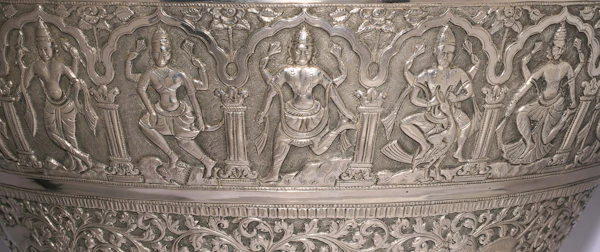
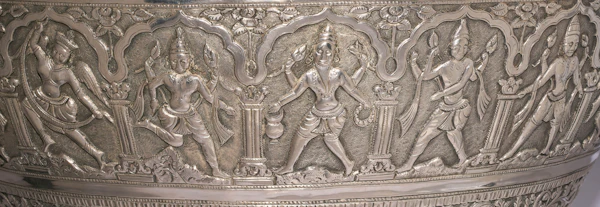
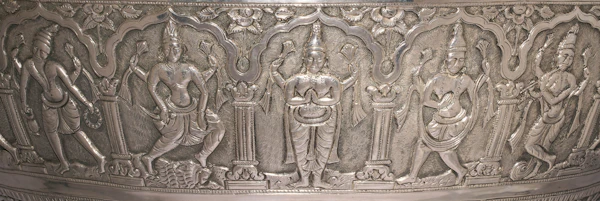
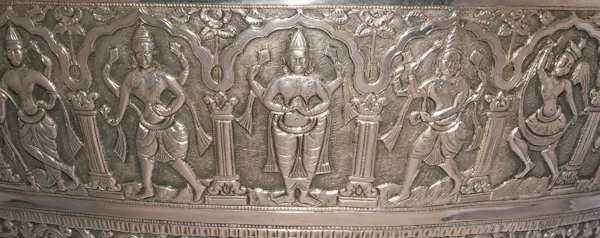
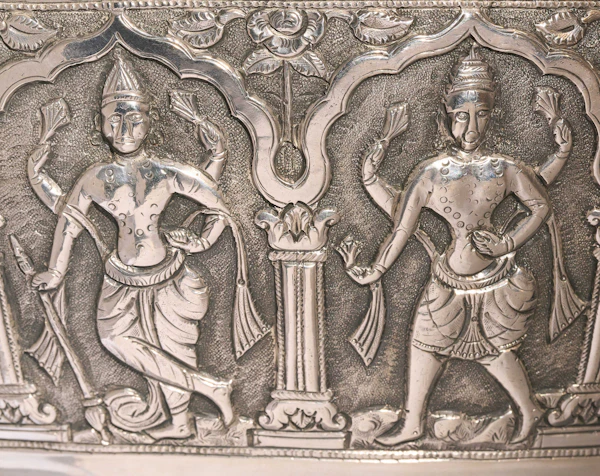
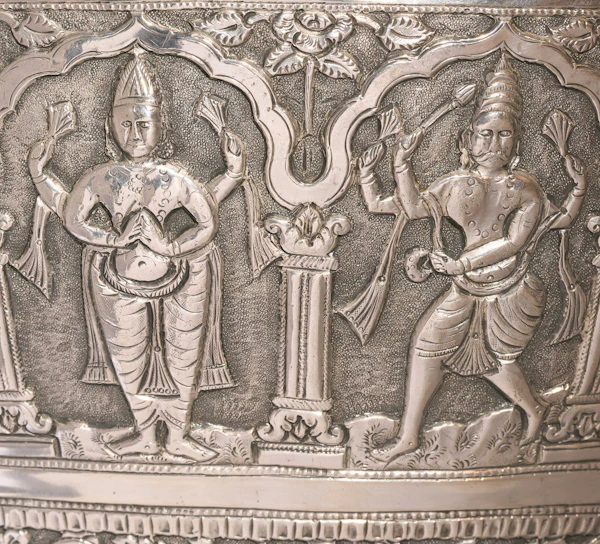
The repoussé figural panels on the vase depict Hindu deities rendered in a stylized western Indian courtly manner, likely inspired by late 19th–early 20th century Gujarati temple and manuscript imagery.
The simplified anatomy and symmetrical framing suggest these were not intended as strict religious icons, but as decorative sacred imagery integrated into luxury court silverwork.
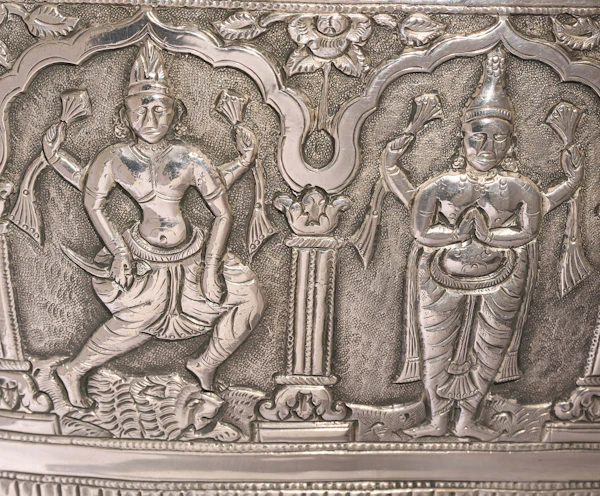
This monumental silver ceremonial Solid Silver Kutch Water Vessel is richly decorated with densely worked floral arabesques and repoussé figural panels depicting Hindu deities, including Shiva and the goddess Durga. Executed in high relief within cusped architectural niches, the figures reflect the hybrid artistic vocabulary of western Indian court silver produced during the late princely era of British India.
The iconography combines sacred Hindu imagery with the luxuriant ornamental style favoured by elite patrons in Gujarat and Bombay workshops around the turn of the twentieth century. Shiva, represented as an ascetic deity holding ritual attributes, appears alongside Durga, the warrior goddess shown triumphing above her animal mount. Their inclusion suggests an artistic synthesis intended to evoke divine protection, prosperity, and royal authority.
Shiva iconography combines ascetic, cosmic, and royal symbolism. Distinguished by the third eye, trident, serpent, crescent moon, and matted locks bearing the Ganges, Shiva appears as yogi, cosmic dancer, and supreme deity. His imagery—especially the Nataraja and linga forms—became central to Hindu religious art and is widely represented in Indian sculpture, painting, silverwork, and temple architecture.
Durga iconography embodies divine feminine power and martial protection. Typically represented with multiple arms bearing the weapons of the gods, mounted upon a lion or tiger, Durga appears most famously as Mahishasuramardini, the slayer of the buffalo demon Mahishasura. Her imagery symbolizes the triumph of cosmic order over chaos and became one of the central themes of Hindu religious art, sculpture, painting, and ritual traditions.
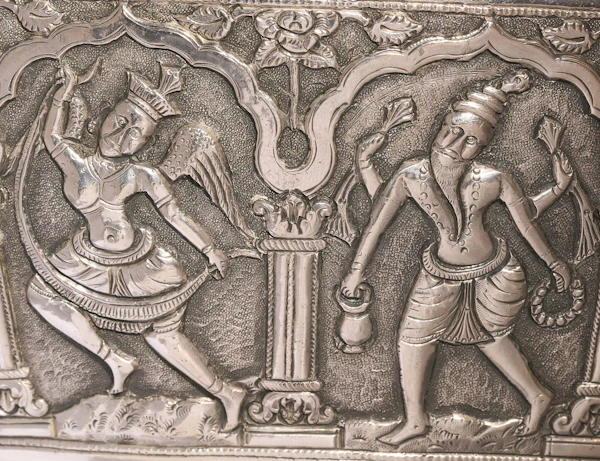
Garuda is the divine eagle-like being who serves as the mount (vahana) of Vishnu. The snake represents the nagas, serpent beings associated with the underworld, hidden power, water, and immortality.
The image of Garuda holding a snake symbolizes:
victory of light over darkness,
divine order overcoming chaos,
protection from evil,
triumph over poison and danger,
spiritual liberation.
Another episode of Krishna slaying Bakasura derives from the Bhagavata Purana, in which the child Krishna defeats the crane-demon Bakasura, sent by King Kamsa to destroy him. After being swallowed whole, Krishna tears apart the demon’s massive beak, symbolizing the triumph of divine purity and protection over deceit and destructive forces.
The next episode of Krishna playing the flute is among the most celebrated themes of Hindu devotional art. As the divine cowherd of Vrindavan, Krishna enchants nature and the cowherd maidens with the music of his bamboo flute, drawing souls toward divine love and spiritual union. The motif became central to Bhakti traditions and is widely represented in Indian painting, sculpture, silverwork, and temple arts.
An additional episode the association of Krishna with the peacock derives from devotional traditions describing the forests of Vrindavan, where peacocks danced ecstatically to the sound of Krishna’s flute. The birds are said to have offered him their feathers, which Krishna placed in his crown. In Indian art, the peacock symbolizes divine beauty, joy, and harmony between nature and the sacred, becoming one of the most recognizable attributes of Krishna iconography.
Krishna iconography combines pastoral, royal, and cosmic symbolism. Distinguished by blue skin, the peacock feather, and the flute, Krishna is represented as divine child, cowherd lover, heroic prince, and spiritual teacher. His imagery—especially scenes with Radha, cows, and the flute—became central to Hindu devotional art and is widely represented in Indian painting, sculpture, silverwork, and temple traditions.
The motif of Garuda grasping a serpent derives from ancient Hindu mythology, in which Garuda—the eagle mount of Vishnu—became the eternal adversary of the naga serpents after obtaining the nectar of immortality to free his mother from bondage. In Indian and Southeast Asian art, the image symbolizes divine protection, royal authority, and the triumph of cosmic order over chaos.
Traditionally associated with the Court of the Nawab of Sachin and reportedly dated 1910, the vase reflects the cosmopolitan culture of the princely state of Sachin near Surat in present-day Gujarat. Although ruled by a Muslim Siddi dynasty of African origin, the court patronized regional artistic traditions that frequently incorporated Hindu mythological imagery into luxury decorative arts.
The vessel’s broad baluster form, flared neck, and exceptionally dense repoussé decoration are characteristic of prestigious presentation silver produced in western India between 1890 and 1915. Such objects were commissioned for palace interiors, ceremonial display, diplomatic gifts, and elite patronage networks during the height of the British Raj.
Materials and Techniques
Silver; repoussé, chasing, engraving, and hand finishing.
Dimensions: -
Width: 35 cm
Height: 36 cm
Total Weight: 3704 grams
| item details | |
|---|---|
| Material and Technique | Silver |
| Origin | Other |
| Period | Early 1900s |
| Condition | Excellent |
| Dimensions | Width: 35 cm Height: 36 cm Total Weight: 3704 grams |
Product REF: JC-07227
