A PAIR OF FINE AND RARE CHINESE FAMILLE VERTE LUDUAN EWERS
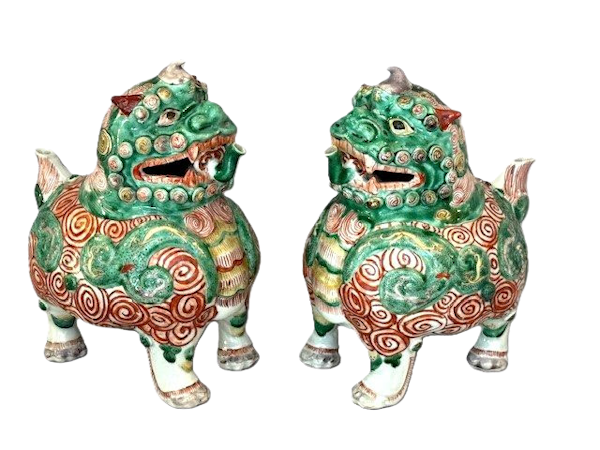

A PAIR OF FINE AND RARE CHINESE FAMILLE VERTE LUDUAN EWERS
POA
Description
The ewers in the shape of mythological beasts standing foursquare, exquisitely moulded head with open mouth, bulging eyes and pronounced eyebrows. Each figure richly decorated in vibrant famille verte green, iron-red, and yellow enamels, with moulded patterns of whorls and spirals, the head raised, with a small 's'-form spout in green enamel between the bared teeth, the a short, hollow tail also raised, the pointed ears set back, with a single horn on the top of the head, the shoulders and haunches with ruyi forms enclosing sprays of chilong and lingzhi plants on a stippled green ground, the scales of the chest and legs painted in iron red, yellow and green.
Period: Kangxi (1662 - 1722)
Footnote: In Chinese mythology, the luduan is an auspicious creature with the ability to detect the truth and travel over great distances in a very short time. It is said to be fluent in all languages of the world. Whenever it encounters a wise and virtuous ruler it offers books as a gift.
Censers in this form were produced in bronze as early as the Han dynasty (206 BC- 220 AD); see an example in the Bondy Collection, illustrated in the Berlin Exhibition of Chinese Art, Berlin, 1929, cat. no. 45. These bronze prototypes were made for the domestic market and inspired later ceramic versions, such as the present pair. These examples were much appreciated in the West, as can be confirmed by the presence of the blanc de chine models of luduan at Hampton court, one of the earliest porcelain collections in Europe (see John Ayers, Chinese and Japanese Works of Art in the Collection of Her Majesty the Queen, pl. 306-307 ). Also see Arts from the Scholar's Studio (1986), Oriental Ceramic Society, Hong Kong, no.232, for a discussion on bronze censers of this type.
Celadon examples with removable heads are known in the Longquan group from the Ming dynasty, 16th - 17th century. Blue and white examples with removable heads are also known in the Ming dynasty, Wanli period. For an extremely fine Wanli example, previously sold by us, now in the Metropolitan Museum.
The next group of this particular type would appear to be the famille verte examples made in the Kangxi period. Interestingly, the few recorded from this period were made, as ours are, in one piece, and had morphed into ewers rather than censers. This particular Kangxi famille verte model closely follows the bronze prototype. With meticulously detailed scales on the chest, curls, and pointed ears, it successfully echoes the subtlety of the bronze prototype.
See the Kangxi famille verte kylin ewers purchased from Anita Gray by the Albuquerque Foundation, Sintra, illustrated in, The RA Collection, Chinese Ceramics, a Collectors Vision, volume 1, published 2011, page 334/335, pl.148.
For other comparable examples of luduan figures with removable heads see: Austellung Chinesischer Kunst, pl. 906 p 334 (Berlin 1929), and a green-glazed example in the Baur Collection, Geneva, vol 4, no. 197.
Quote from Margaret Medley, Handbook of Chinese Art: 'The fabulous animal known as kylin, sometimes called the Chinese unicorn. It may be leonine, with scales and horns, or it may be an elegant cloven-footed beast, with or without scales, with a bushy mane and tail, and a horn, or a pair of horns. Variations are extremely numerous and impossible to classify satisfactorily as the Chinese have in the past, given this name to many animals, including the giraffe.'
| item details | |
|---|---|
| Origin | Chinese |
| Period | 18th Century |
| Dimensions | 22cm high |
Product REF: BJ71
