A CHINESE BLUE AND WHITE ‘KRAAK’ DISH


A CHINESE BLUE AND WHITE ‘KRAAK’ DISH
POA
Description
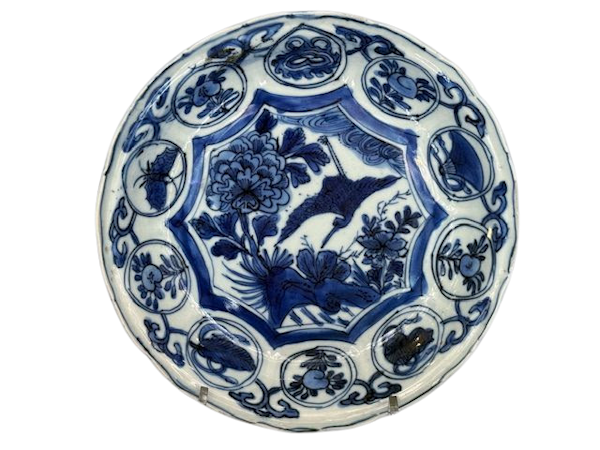
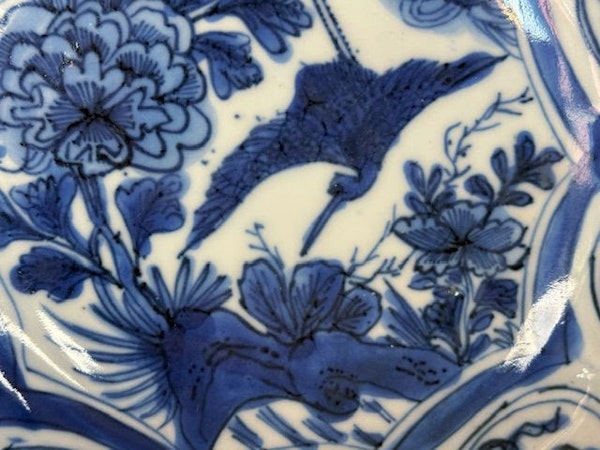
Of circular form with foliate rim, decorated in varying shades of underglaze blue, the well painted with the unusual scene of a crane among rockwork and large chrysanthemum blooms enclosed within a pentagonal border, the cavetto decorated with ten rounded panels, each enclosing either a peach branch or an auspicious object, including a fan, a ruyi head and a double gourd vase, all interlinked with a scrolling vine, the reverse decorated with ten panels each enclosing an abstract dot design, the glazed base with a 'Bluett and Sons' label.
Period: Kangxi (1662 - 122)
Provenance
Collection of B. Magowan, via a deceased Estate, with Bluett & Sons, London label.
Footnote
Our dating for the present dish is based on an example illustrated Maura Rinaldi, Kraak Porcelain - A Moment in the History of Trade, Bamboo Publishing Ltd, London 1989, pl.106, p.110. Rinaldi gives the early date of c.1595-1610 to her example. The present dish shares distinctive 'drop-shaped' panels, unusual pentagonal central medallion, and deep blue colour with the example presented by Rinaldi.
A dish with comparable panels and central medallion can be found in the collection of the Topkapi Museum, see: Ayers & Krahl, Chinese Ceramics in the Topkapi Museum, vol.2, p.774, fig.1474.
The crane is said to live up to 1,000 years. The high-soaring crane was the transport used by the immortals to go to heaven. Formal Daoists' gowns often have flying cranes as a decorative motif and the combination of cranes and the Eight Trigrams known in Chinese as bagua often adorn Daoist ceremonial objects.
During the Ming and Qing dynasties the most senior grade of imperial civil servants wore a white crane rank badge or mandarin square in front of their chest. showing the crane was held in high regard.
The crane mandarin square when combined in a crane, water, clouds, and blue sky design reflects the emphasis on the wisdom and talent of the Chinese Imperial court's civil officials. Artists often present the crane within a circle, since the roundness indicates 'perfection'.
| item details | |
|---|---|
| Origin | Chinese |
| Period | 16th Century |
| Diameter | 21cms, 8 inches |
Product REF: BJ29
