A FINE RARE CHINESE KANGXI BLUE AND WHITE MINIATURE VASE


A FINE RARE CHINESE KANGXI BLUE AND WHITE MINIATURE VASE
POA
Description
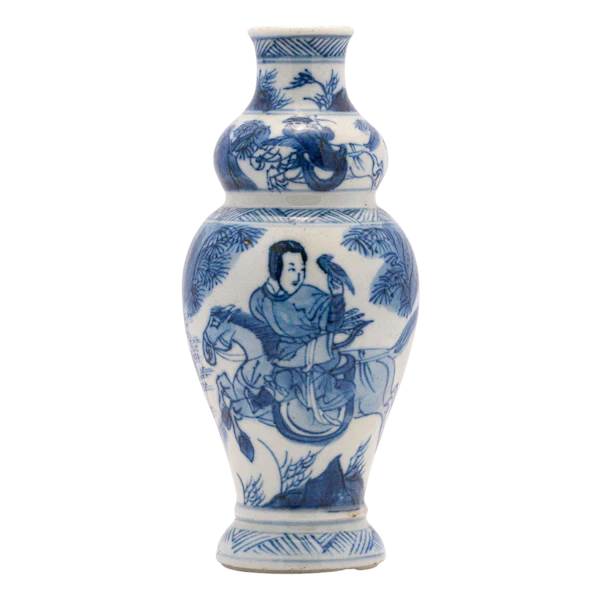
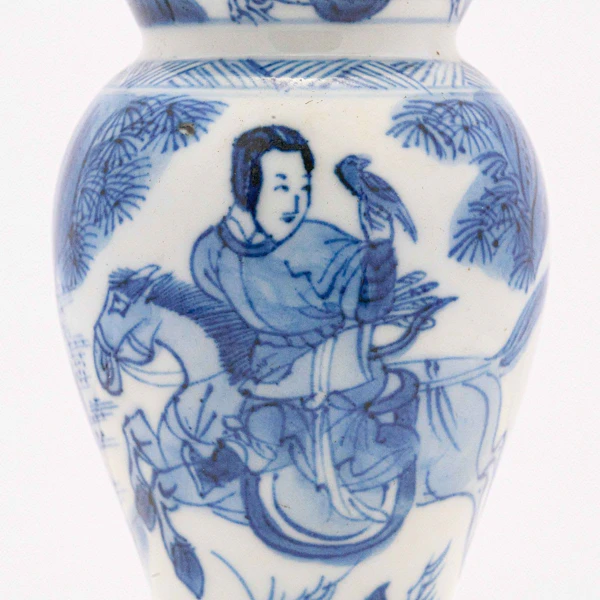
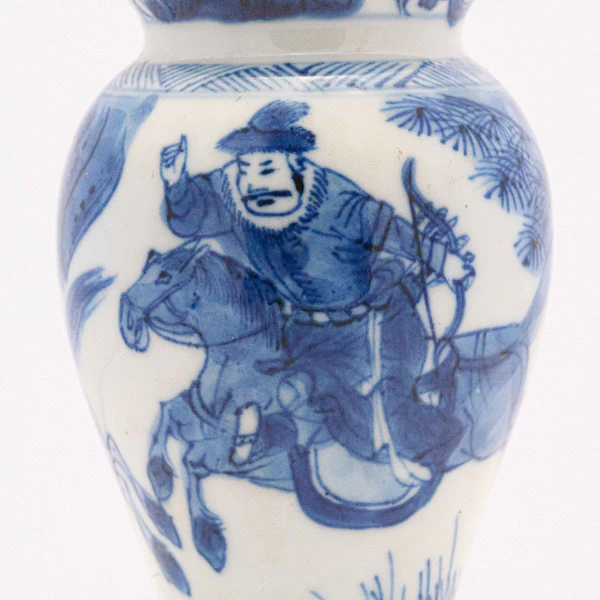
Of unusual form, the slender baluster body supported on a raised and gently sloped foot, surmounted by a rounded upper section rising to a short waisted neck, decorated in bright shades of cobalt blue, the body painted with a lively scene of two huntsmen astride horses in full gallop, their ears folded back, one with a bow and quiver of arrows, one holding a hunting hawk in one hand, all among bamboo and foliage, between triangle-work borders at the shoulder and foot, the compressed upper section further decorated with a huntsman on horseback, the neck decorated with a band of rocks and foliage, a further band of triangle-work at the neck.
Period: Kangxi (1662 - 1722)
Footnote:
The figures' robes and elegant posture suggest these are probably scholar-gentlemen or noblemen at leisure not an active hunting scene.
Scenes depicting an archer and falconer both on horseback carries symbolic and cultural meaning. The archer represents skill and courage. Archery was considered one of the classical accomplishments valued in Chinese elite culture. Falconry was also seen as an elite pastime. Records of both mounted falconers alongside mounted archers can be seen in Eastern Han (A.D. 25-220) tombs from Shaanxi and Shanxi reflecting the assimilation of Central Asian and northern nomadic traditions into Han culture.
The most iconic painting depicting archers on horseback together with falconers on horseback is "Kublai Khan on a Hunting Expedition" (1280) by the court artist Liu Guandao. This perfectly illustrates the synthesis of nomadic hunting traditions—combining mounted archery, falconry, and amazingly, trained cheetahs !
The specific combination of mounted archers and falconers became popular on ceramics during the Kangxi (1662–1722) period, possibly because the ruling Qing emperors were Manchus and the design celebrated their heritage of equestrian archery and falconry.
| item details | |
|---|---|
| Origin | Chinese |
| Period | 17th Century |
| Dimensions | Height: 9cms, 3.5 inches |
Product REF: BJ94
