Antique Chinese Silver Rosewater Sprinkler, Bird, Canton, China - Qing Dynasty, mid-19th C.
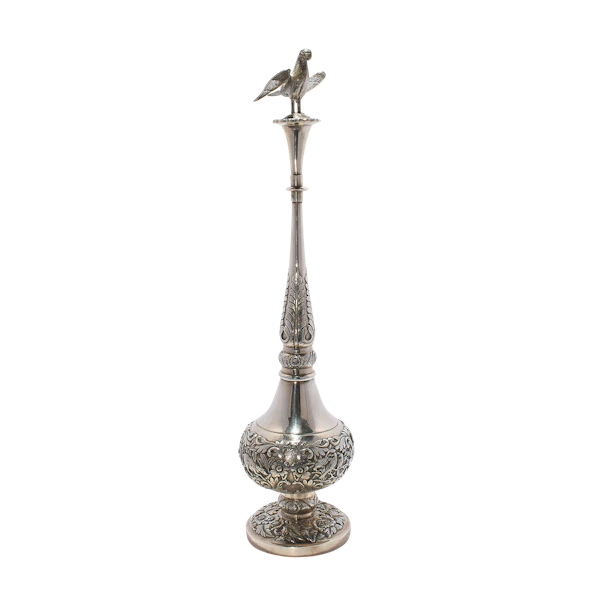


Antique Chinese Silver Rosewater Sprinkler, Bird, Canton, China - Qing Dynasty, mid-19th C.
£3,250.00
Description
This fine antique Chinese silver sprinkler was made in Canton around the middle of the 19th century and carries a silver mark for the Canton retail silversmith who used a ‘Gothic K’ as his cipher. This firm was unusual in that it created a wide range of objects, including items of Judaica and Islamic silver, alongside items in Chinese style. Often, objects they produced had a Chinese form but had little Chinese ornamentation, perhaps indicating that a significant number of their clients were either Muslim or Jewish.
In the latter half of the 19th century, a significant number of affluent Jewish and Muslim merchants were involved in the China Trade and many were also living in Hong Kong or China. Most had their origins in the Indian sub-continent, but others came from the Middle East and the countries straddling the Silk Road. Rosewater sprinklers such as this, were traditionally not used by Chinese or Europeans but were used ceremonially by Sephardi and Mizrachi Jews and by Muslims, at weddings, feasts and in welcoming ceremonies.
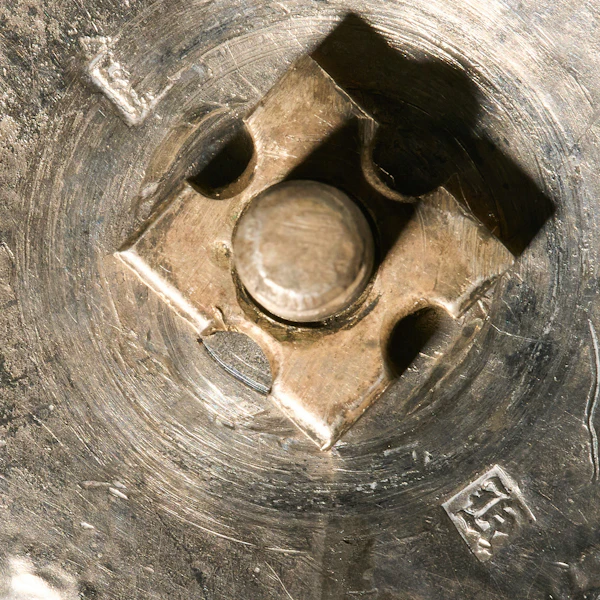
This sprinkler has an inscription around the side of the foot, which has been photographed. The writing has been pricked out and we do not know which language this is in or what it says. To the underside of the base is the ‘Gothic K’ silver mark, which has also been photographed. This mark was used between the years of, roughly 1830 and 1880. The photo of the underside also reveals a distinctive quadrilobed nut, a characteristic and very distinctive shape of nut which is only ever found on silver objects of Chinese origin.
The sprinkler has been ornamented using repousse and chased techniques and this is still very crisp and sharp. It can be easily disassembled by unscrewing the various parts, which allows the globular container to be filled with scent.
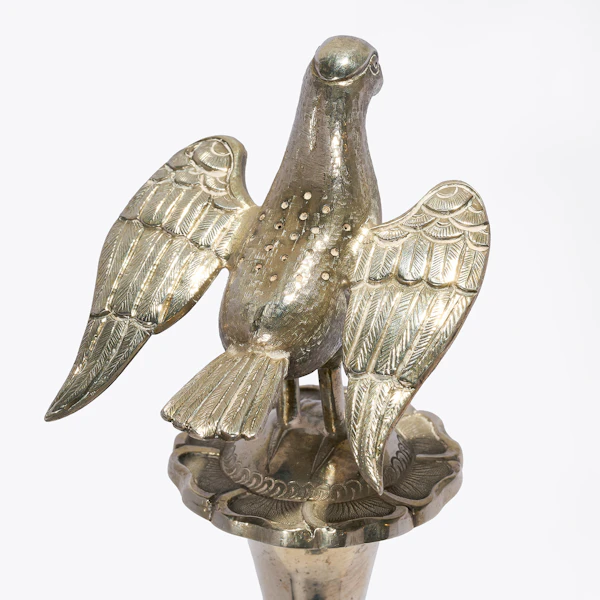
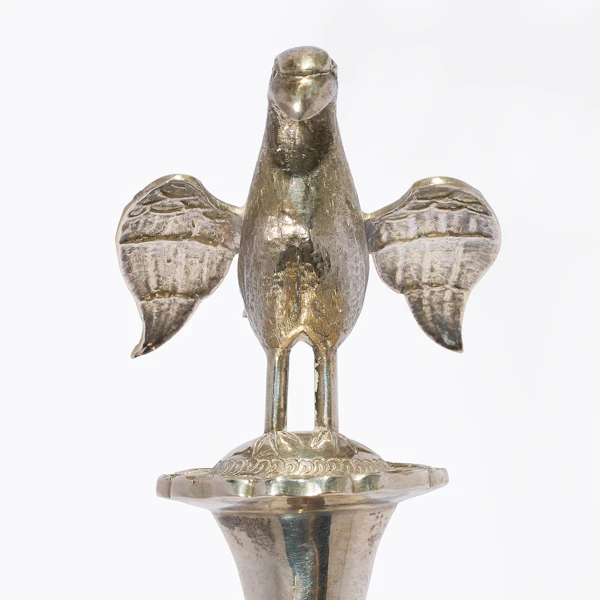
Unusually, this sprinkler has the figure of a bird, probably a parrot or parakeet, to the top. The bird stands erect with its two feet planted firmly on the ground and its wings outspread. It appears to be standing on top of a small hummock, which is in fact the centre of a traditional flowerhead, a feature which can usually be found at the top of these vessels where it signifies the purpose of the container and functions as the rose or sprinkler. In this case, the actual sprinkler is the bird itself and the rosewater droplets emanate from the fine holes in the bird’s back. The bird figure has been finely modelled and well detailed, as have the petals of the flower it stands on. The feathers of the wings and tail have been delicately chased whilst those to the back of the bird have not.
Under the bird and flower is an elegant and elongated neck of plain silver, which flares gently outwards towards the top and bottom of its length. The line of the neck is interrupted by one protruding flanged knop, which forms a finger rest when using and allows the rose to be unscrewed from the neck for cleaning purposes. The lowest part of the neck is encircled with a border of large and elongated acanthus leaves stretching upwards, emphasising the length of the neck. These leaves sit above a convex ring knop ornamented with chased roundels interspersed by leaves. A similar, but larger knop, forms the vessel’s short stem, connecting the globular body with the pedestal foot below and creating visual balance.
The bulbous part of the sprinkler forms the reservoir which holds the rosewater. There is no ornamentation to the top third, but around the widest part is an explosive border of flowers and high relief, almost, three-dimensional foliage, which surrounds the small scenes. The foliage has great depth and movement; the raised leaves arch and curl and the whole effect is in sharp contrast to the area of plain silver above and the narrow plain silver bands to the top and bottom of the stem and around the side of the pedestal foot. The veins of the leaves and the centres of the flowers have been finely and expertly chased showing both restraint and great mastery of the medium. The top face of the foot has been ornamented in similar style with floral and foliate imagery.
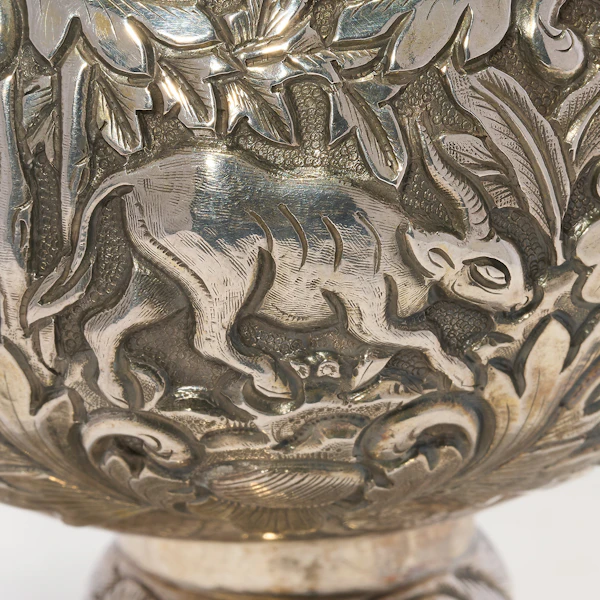
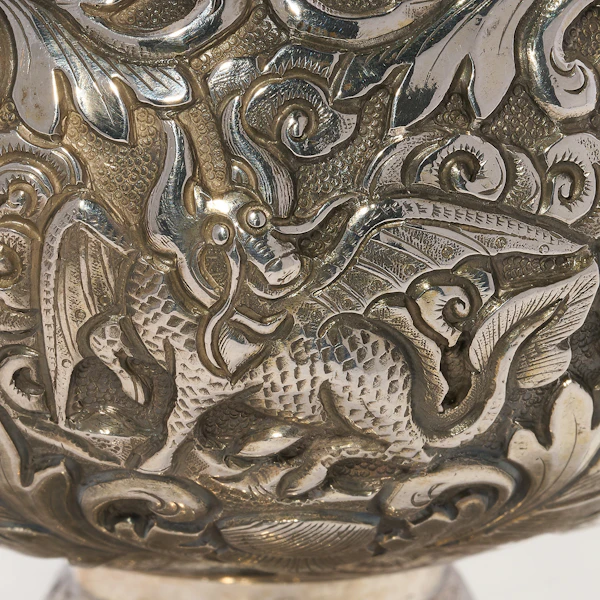
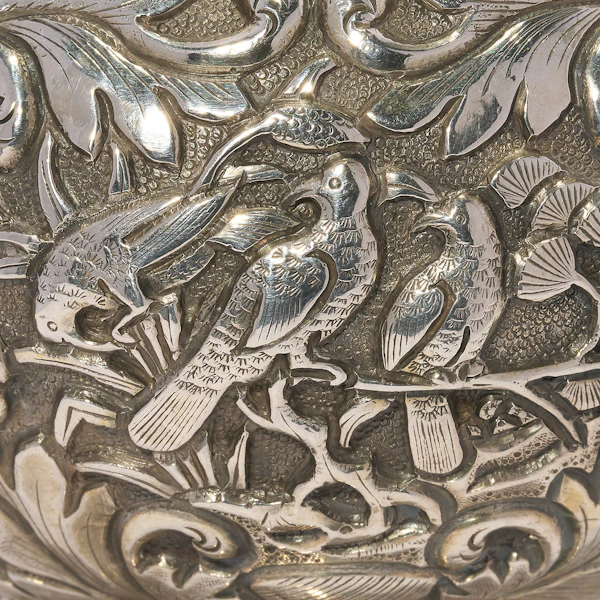
The three scenes appear to represent the circle of life and all of God’s creatures, those which inhabit the earth and the mythical or divine. The scenes focus our minds on life and procreation, death and decay and immortality by portraying a mythical and divine being in the heavens, a mammal on land and the birds of the air.
The four small scenic panels are framed by leaves and flowers. The flowers and foliage are not those typically found ornamenting Chinese silver such as plum blossom, bamboo, pine, chrysanthemums and paeony. The flower of one ‘frame’ meets the flower of the adjoining frame at the vertical centre. Above and below these meeting points are irregular apertures filled with a fine and very restrained linear triangular grid or trellis pattern. These serve as ‘quiet’ spaces providing calm and contrast within the design whilst emphasising the height of the surrounding relief and separating the scenes.
One scene shows a mythical kylin with outstretched wings flying amongst the clouds. Kylins are believed to be composite creatures. In the Qing dynasty they were usually portrayed with the head of a dragon, the antlers of a deer, the skin and scales of a fish, the hooves of an ox and the tail of a lion. Many Asians, including the Chinese, regard the kylin as a divine and peaceful creature. They believe that kylins do not eat flesh and that they take great care when and where they walk, to avoid treading on another living creature. Therefore, they are often shown amongst the clouds or walking on water. They also believe that kylins only appear in areas or buildings ruled by a wise and benevolent leader, which can include a household.
The scene showing three birds perched on the branch of a pine tree is repeated twice. Two birds appear to be a pair and the other one a spare! Under the branch is a nest holding three eggs, signifying the approaching birth of the next generation. The third scene features an antelope, lying on the ground with slashes to its side. It is dead and appears to have been attacked and killed by a predator, such as a tiger, which has eaten some of the corpse and disappeared.
Dimensions: Height 40 cms; Width 11cms
Weight: 470 grammes
Provenance:- European art market
References:-
Adrien Von Ferscht, Chinese Export Silver 1785-1940, The Definitive Collectors’ Guide, 4th Edition, 2015
| item details | |
|---|---|
| Origin | Chinese |
| Period | Early 1900s |
| Condition | Excellent |
| Dimensions | Dimensions: Height 40 cms; Width 11cms Weight: 470 grammes |
| Diameter | 11cm |
Product REF: JC-SPRI-07234
