Solid Silver Hallmarked Kohen Handwashing Jug from the Kalisher Synagogue on the occasion of Simchat Torah, Maker’s Mark R.K, Rubin Koshr (Kusher), 1906
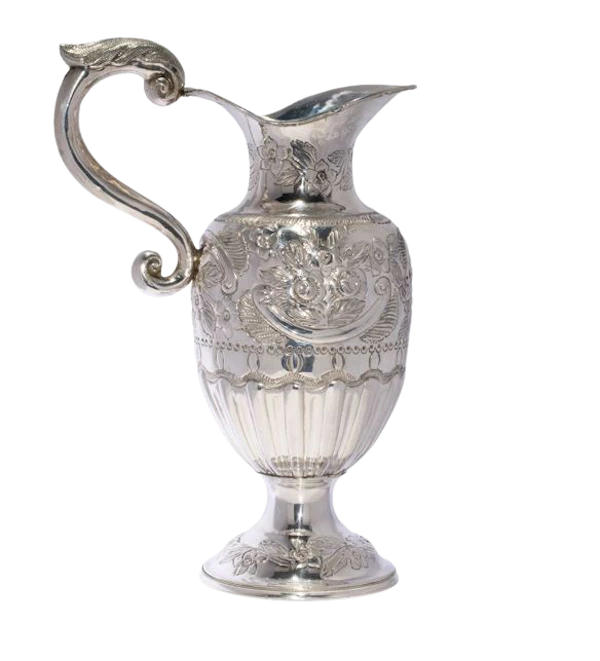
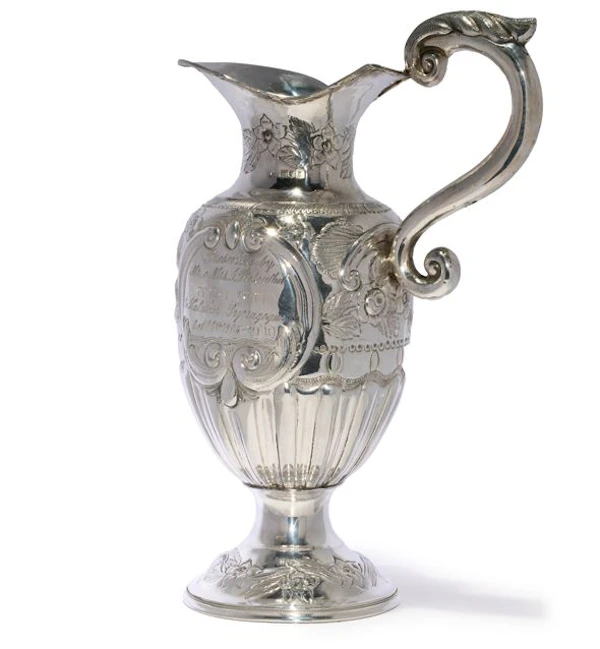
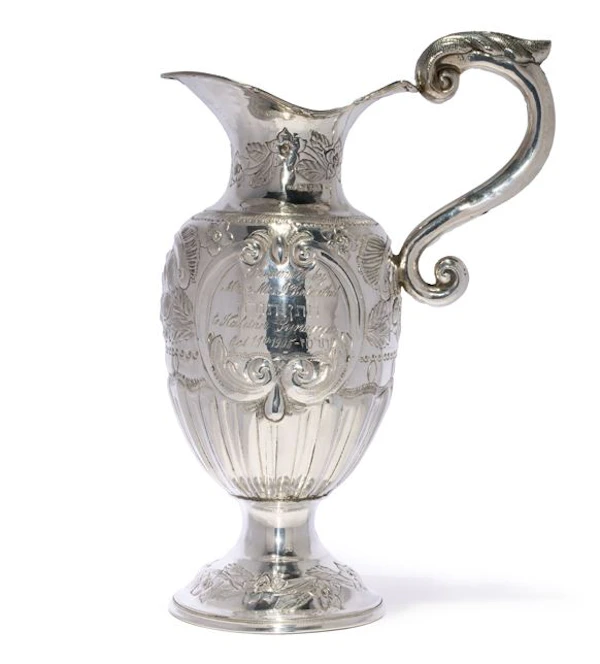


Solid Silver Hallmarked Kohen Handwashing Jug from the Kalisher Synagogue on the occasion of Simchat Torah, Maker’s Mark R.K, Rubin Koshr (Kusher), 1906
£3,500.00
Description
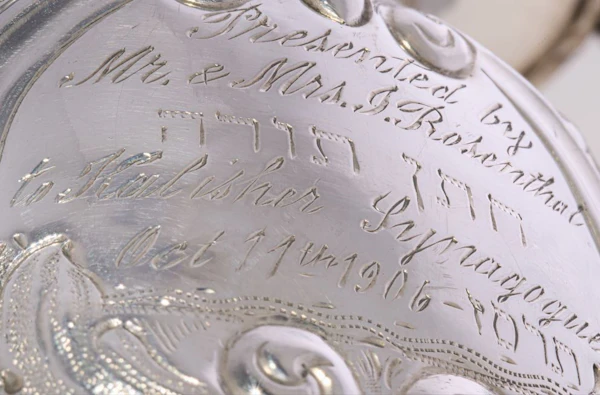
Solid Silver Hallmarked Kohen Handwashing Jug from the Kalisher Synagogue on the occasion of Simchat Torah, Maker’s Mark R.K, Rubin Koshr (Kusher), 1906 This ornamental hand washing jug, dedicated to the Kalisher Synagogue in 1906, was used for washing the hands of Kohanim (Priests) prior to when they assemble before and blessing the congregation in the synagogue. The matter of washing the priests’ hands before the ritual Birkat Kohanim (The Priestly Benediction) is discussed in the Talmud, with Rabbi Yehoshua ben Levi stating that the Kohanim should not lift their hands to recite the blessing with unwashed hands.1 The Levites (descendents from the tribe of Levi) wash the hands of the priests before they proceed to bless the congregation.2 3 The inscription on the jug is mostly in English, stating that it was presented to the Kalisher Synagogue by “Mr & Mrs J Rosenthal”. Beneath their name the Hebrew inscription reads חתן
תורה (Chatan Torah), meaning ‘bridegroom of the Torah’. This inscription firmly places this jug
in the context of the Jewish festival ‘Simchat Torah’, which occurs annually to mark the completion of reading the weekly Torah portions. The Chatan Torah is a congregant selected by a community and is honoured through reading the final verses of the Torah, which is the description of the death of Moses in Deuteronomy.4 Therefore, this jug represents gratitude for this prestigious designation within the Simchat Torah ceremonies and celebrations, with the appreciative gift of a ritual object to the synagogue demonstrating the importance that the honour had for the honoree. The inscription includes the date, ‘October 11th 1906’ along with the Hebrew year, ‘ .’תרסז
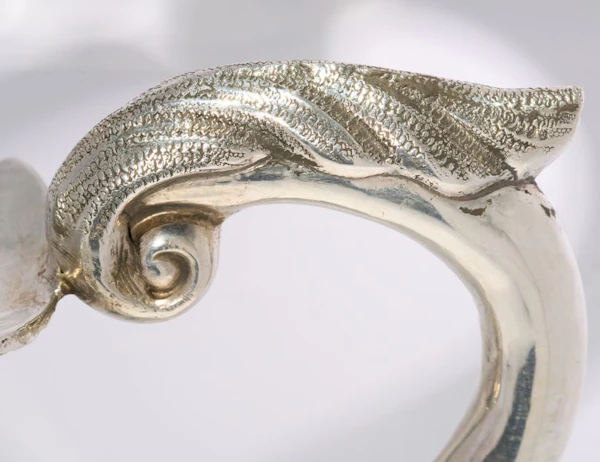
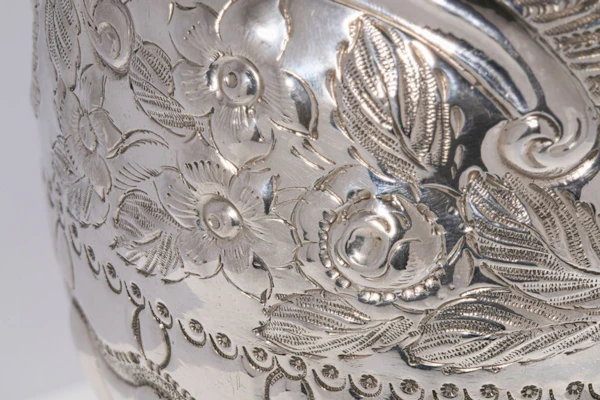
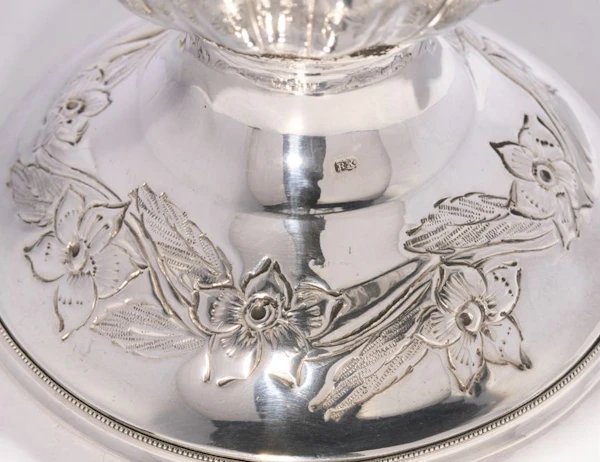
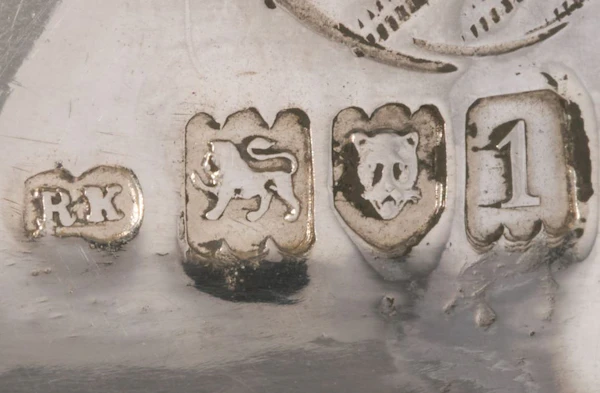
This hand washing jug is extremely ornamental, consisting of intricate curling floral shapes which embellish the large handle and base. Between the thick, swirling contours are depictions of large flowers. These are enhanced by the shape of the jug which is fashioned after classical forms which incorporate a flamboyant design. The monumental size of the jug also demonstrates how privileged Mr J. Rosenthal felt about the honour bestowed upon him by the Kalischer Synagogue, with the extravagance of the jug’s design, motifs and the size of the object clearly being indicators of this. A notice published in the newspaper The Jewish Chronicle in 1873 details the consecration of a new synagogue in Steward Street, Spitalfields. The article states that this synagogue developed from a society founded three years prior called the ‘Kalischer Chebra’, which was formed as a charitable initiative for the inhabitants of the town of Kalisch, Poland. The article states that the society purchased a warehouse to be converted into a synagogue, noting that it was currently incomplete, by “Mr George Lewis, of Sandys’ Row”.5 The reference to Sandy’s Row is notable, as the latter synagogue shared a similar origin with the Kalischer Synagogue, founded by Dutch Ashkenazi working men in 1853-4,6 its Chevra (Society) being integral to its development,7 as well as being under the Federation of Synagogues.8 Receiving and offering gifts occurred within the Kalischer synagogue in the subsequent years. The Jewish Chronicle in 1875 notes that a special gift of a silver snuff box was given from the synagogue to Mr Nathan Israel while Raphael Capland was presented with a silver kiddish cup.9 In 1895, the Kalischer Synagogue merged with the Windsor Street Chevra to form the Alie Street Synagogue.10 However, despite the merger and new name, the synagogue was still frequently referred to as the Kalischer Synagogue, as can be seen in the Jewish Chronicle obituary of Rabbi Israel Dainow in 1922, who became the rabbi of the synagogue in 1877,11 as well as on this handwashing jug from 1906. In 1969, Alie Street Synagogue closed and amalgamated with another historic synagogue, Fieldgate Street Great Synagogue, which closed and was converted to a mosque in 2015.12 The Maker’s Mark ‘R.K.’ on the jug corresponds to the silversmith Rubin Koshr (also known as Kusher), and appears to have been operational between 1900 to 1906.13 This ornate solid silver handwashing Kohen jug is a fascinating example of East End Jewish history, demonstrating the economic development and stability the established immigrant Jewish community in the East End of London began to experience in the early 20th century. Inscription: Presented by Mr & Mrs J Rosenthal Chatan Torah to the Kalisher Synagogue October 11th 1906 תרסז
1 BT Sotah, 39a. Sefaria.
2 Zohar III 146a–b..
3 Yehoshua Pfeffer, Parshas Korach-The Levite Task of Washing Kohanim’s Hands, ‘Beit HaHorah
HaMrcazi L’Dinot Din’, 23rd of June 2011 [accessed 20th May 2025]
4 Richard M. Davidson, ‘Simhat Torah: The Joy of the Bible’, Shabbat Shalom, (December 1995)
5 ‘Consecration of a New Synagogue in Spitalfields’, The Jewish Chronicle, 12th September 1873
6 Edward Jamilly, Anglo-Jewish Architects, and Architecture in the 18th and 19th Centuries, Transactions
(Jewish Historical Society of England), Vol. 18 (1953-1955)
7 Saskia Coenan Snyder, Building a Public Judaism: Synagogues and Jewish Identity in Nineteenth
Century Europe, (Cambridge, MA & London: Harvard University Press, 2013),
8 John Marriott, Beyond the Tower: A History of East London (New Haven and London: Yale University Press, 2011).
9 The Jewish Chronicle, 29th October 1875
10 Survey of London, ‘Central House’,
11 JCR-UK, ‘the former Alie Street Synagogue, Aldgate, London E1’,
12 The Jewish Chronicle, ‘East End Synagogue is sold to its Muslim neighbours’,
13 Silver Makers’ Marks - London Assay Office (R), ‘RK’,
Measurements:
Length: 195 mm
Width: 280 mm
Weight: 646 grams
| item details | |
|---|---|
| Material and Technique | Silver |
| Origin | British |
| Period | 20th Century |
| Condition | Excellent |
| Dimensions | Length: 195 mm Width: 280 mm Weight: 646 grams |
Product REF: JC-JUDA-07225
